sadalawpublications.com

Indian judiciary

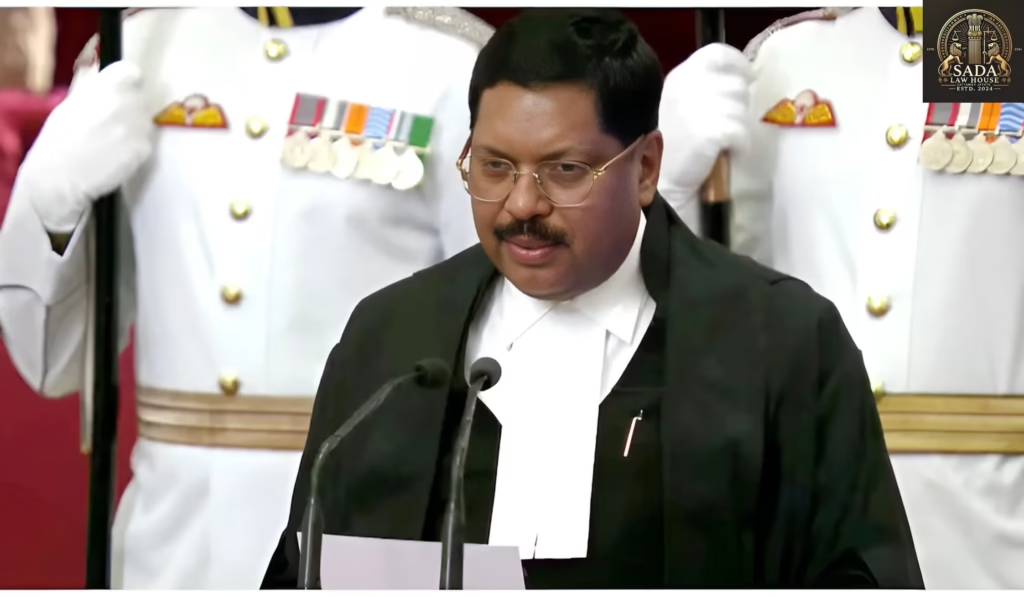
Justice B.R. Gavai Sworn In as India’s 52nd Chief Justice, First Buddhist CJI in History

Trending Today Justice B.R. Gavai Sworn In as India’s 52nd Chief Justice, First Buddhist CJI in History Supreme Court Verdict on EWS Quota: Janhit Abhiyan vs Union of India (2022) – Constitutional Validity of 103rd Amendment Scope of Court’s Power Under Section 319 CrPC to Summon New Accused After Trial: Supreme Court Judgment in Sukhpal Singh Khaira Case Sonu Nigam Seeks Dismissal of FIR Over Alleged Remarks Against Kannadigas at Bengaluru Concert Supreme Court Revokes Ban on ‘4PM News’ YouTube Channel, Questions IT Blocking Rules Allahabad High Court Stays Suspension of UP DSP Accused of Extramarital Affair Three Lashkar Militants Killed in Shopian Encounter Amid Rising India-Pakistan Tensions Pakistan Admits Aircraft Damage After Precision Indian Strikes in Operation Sindoor Rahul Gandhi Faces Court Complaint Over “Mythological” Remark About Lord Rama in US Delhi Airport Disruptions: 97 Flights Cancelled, 150 Delayed Amid Regional Tensions Justice B.R. Gavai Sworn In as India’s 52nd Chief Justice, First Buddhist CJI in History MAHI SINHA 14 May 2025 Justice B.R. Gavai becomes the 52nd Chief Justice of India, marking a historic milestone as the first Buddhist and second Dalit CJI. Discover his legal journey and impact on SC representation. Justice B.R. Gavai Sworn In as the 52nd Chief Justice of India In a historic ceremony held at the Rashtrapati Bhavan on May 14, 2025, Justice Bhushan Ramkrishna Gavai was officially sworn in as the 52nd Chief Justice of India (CJI). The oath was administered by President Droupadi Murmu. Historic Firsts: Buddhist and Dalit Representation Justice Gavai’s appointment marks a significant moment in Indian judicial history. He is the first member of the Buddhist community and only the second Dalit to hold the office of CJI, following Justice K.G. Balakrishnan. He succeeds Justice Sanjiv Khanna, who retired on May 13, 2025. Justice Gavai will serve as Chief Justice until his retirement on November 23, 2025. Early Life and Background Born on November 24, 1960, in Amravati, Maharashtra, Justice Gavai hails from a family rooted in Ambedkarite values. His father, R.S. Gavai, was a prominent leader of the Republican Party of India and served as governor of Bihar, Sikkim, and Kerala. Legal Career and Judicial Service Justice Gavai began his legal career under the mentorship of Bar. Raja S. Bhonsale, a former High Court judge. Between 1987 and 1990, he practiced independently at the Bombay High Court, later focusing on its Nagpur Bench from 1990 onward. He practiced constitutional and administrative law, representing public entities like SICOM and several municipal corporations. Justice Gavai also served as: Standing Counsel for Amravati University and local municipal bodies Additional Public Prosecutor and Assistant Government Pleader (1992–1993) Government Pleader and Public Prosecutor at Nagpur Bench (2000) He was appointed an Additional Judge of the Bombay High Court on November 14, 2003. Rising Representation in the Supreme Court Justice Gavai’s elevation reflects a rising trend in the Supreme Court of India‘s inclusivity. Alongside Justice C.T. Ravikumar and Justice Prasanna B. Varale, he is one of three active Justices from the Scheduled Caste (SC) community—an unprecedented level of representation in the Court’s history. Notably, both Justice Gavai and Justice Varale are Buddhists, making this the first time two Buddhist justices serve concurrently on the Supreme Court bench. Conclusion: A Landmark Moment in Indian Judicial History The appointment of Justice B.R. Gavai as the 52nd Chief Justice of India is not just a personal milestone—it is a historic moment for India’s judiciary. His journey from Amravati to the nation’s highest judicial office underscores the progress toward greater representation and inclusivity in the legal system. As the first Buddhist and second Dalit to assume this esteemed role, Justice Gavai’s tenure symbolizes hope, diversity, and justice for all communities. His legacy will likely inspire generations of legal minds committed to equality and constitutional integrity. Leave a Reply Cancel Reply Logged in as Sada Law. Edit your profile. Log out? Required fields are marked * Message* Live Cases Justice B.R. Gavai Sworn In as India’s 52nd Chief Justice, First Buddhist CJI in History Justice B.R. Gavai Sworn In as India’s 52nd Chief Justice, First Buddhist CJI in History Sada Law • May 14, 2025 • Live cases • No Comments Sonu Nigam Seeks Dismissal of FIR Over Alleged Remarks Against Kannadigas at Bengaluru Concert Sonu Nigam Seeks Dismissal of FIR Over Alleged Remarks Against Kannadigas at Bengaluru Concert Sada Law • May 14, 2025 • Live cases • No Comments Supreme Court Revokes Ban on ‘4PM News’ YouTube Channel, Questions IT Blocking Rules Supreme Court Revokes Ban on ‘4PM News’ YouTube Channel, Questions IT Blocking Rules Sada Law • May 14, 2025 • Live cases • No Comments 1 2 3 … 5 Next »

Justice B.R. Gavai Sworn In as India’s 52nd Chief Justice, First Buddhist CJI in History Read More »
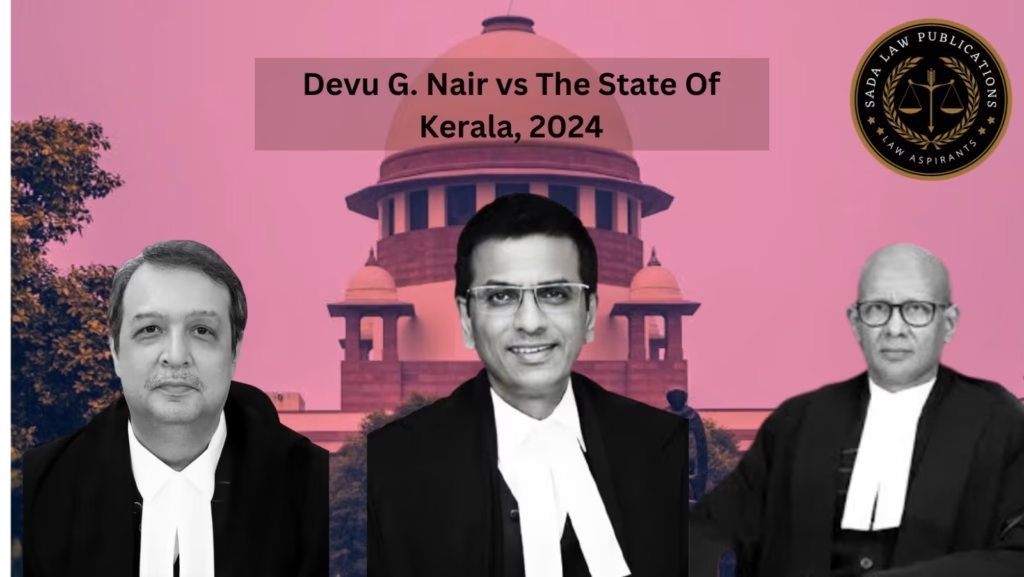
Supreme Court Upholds LGBTQ+ Autonomy in Habeas Corpus Case: Guidelines Issued to High Courts

Trending Today Supreme Court Upholds LGBTQ+ Autonomy in Habeas Corpus Case: Guidelines Issued to High Courts Supreme Court Overturns Remission in Bilkis Bano Case: 2002 Gujarat Riots Convicts Ordered Back to Jail Supreme Court Grants Chhattisgarh State Option to Seek Case Transfer Amid Heated Liquor Scam Hearing Byju’s Withdraws Supreme Court Petition on Aakash Ownership: Karnataka HC Ruling Stands Supreme Court Affirms Group of Companies Doctrine: Non-Signatories Can Be Bound by Arbitration Agreements Punjab & Haryana High Court Orders Removal of Unauthorized Gurudwara and Temple in Kharar Punjab and Haryana High Court Questions POCSO Court on Victim’s Surrender as Prosecution Witness in Rape Case Supreme Court Demands Action from CAQM Over Bandhwari Landfill Fires in Gurugram Supreme Court Upholds TDS on Salaries of Christian Nuns and Priests, Dismisses Review Petitions Actor-Activist Sushant Singh Moves Supreme Court to Transfer Petition Challenging IT Rules Petition Amid Social Media Blocking Dispute. Supreme Court Upholds LGBTQ+ Autonomy in Habeas Corpus Case: Guidelines Issued to High Courts NITU KUMARI 04 May 2025 The Supreme Court of India, in the 2024 Devu G. Nair v. State of Kerala case, reinforced LGBTQ+ rights, personal liberty, and the legitimacy of chosen families. Learn about the key guidelines issued to High Courts in habeas corpus and protection petitions. Supreme Court Reinforces LGBTQ+ Autonomy and Personal Liberty in Habeas Corpus Case On March 11, 2024, the Supreme Court of India delivered a historic judgment in the case of Devu G. Nair vs. The State of Kerala, affirming the autonomy and dignity of LGBTQ+ individuals. The Court issued a set of critical guidelines to High Courts regarding the handling of habeas corpus petitions and protection petitions, especially those involving sexual orientation and identity. Case Background – Devu G. Nair v. State of Kerala In this case, the petitioner alleged that her close companion, referred to as “X”, was being unlawfully confined by her natal family due to their intimate relationship. The Kerala High Court initially directed “X” to undergo counseling, raising concerns about interference with personal liberty. The Supreme Court, led by Chief Justice DY Chandrachud and Justices JB Pardiwala and Manoj Misra, examined whether the High Court’s order violated the individual’s right to choose their relationships and living arrangements freely. Key Legal Issues Addressed  Violation of Autonomy through Forced CounselingThe Court analyzed whether court-ordered counseling infringed on the autonomy and dignity of “X”, particularly when it could be used to suppress her sexual orientation. Protection of LGBTQ+ Individuals in Legal ProceedingsThe Court also considered what safeguards courts should implement when hearing habeas corpus petitions involving LGBTQ+ persons. Arguments Presented Petitioner’s ViewpointThe petitioner emphasized that members of the LGBTQ+ community often face violence, emotional abuse, and rejection by their biological families. The concept of a “chosen family”—comprised of friends and intimate partners—holds vital importance in their lives. Any directive for therapy or family counseling may reinforce harmful societal biases. Respondent’s Standpoint“X” claimed she was staying with her parents of her own free will and referred to the petitioner as an “intimate friend.” She also stated she did not wish to live with or marry anyone at that time. However, concerns were raised about the potential misuse of counseling to manipulate her sexual identity and choices. Supreme Court Verdict and Key Takeaways Ratio Decidendi (Binding Legal Principle) Right to Choose RelationshipsAdults have the constitutional right to determine their own relationships and living situations without undue interference. Judicial Limits in LGBTQ+ CasesCounseling must not be weaponized to alter someone’s sexual identity or relationship preferences. Recognition of Chosen FamiliesThe Court recognized chosen families as equal in importance to biological families, especially for marginalized communities. Obiter Dicta (Judicial Commentary) The judiciary must remain impartial and avoid reinforcing societal prejudices. Courts should ensure that they do not become tools of coercion, particularly in matters involving identity and individual liberty. Guidelines Issued to High Courts The Supreme Court laid down the following judicial guidelines for handling similar cases: Prioritize Personal Liberty: Habeas corpus petitions must be resolved swiftly, focusing on the freedom of the individual. Ensure Private Interaction: Judges should ensure that individuals can meet and speak freely with legal representatives or partners in a safe, non-coercive environment. Avoid Forced Counseling or Parental Custody: Courts must not suggest therapy or parental care that could stigmatize or pressure LGBTQ+ individuals. Show Empathy and Protect Privacy: The judiciary should treat such matters with compassion and preserve the individual’s dignity. Provide Immediate Protection: Where necessary, courts should arrange police protection to safeguard individuals from threats posed by natal families. Conclusion – A Milestone for LGBTQ+ Rights in India This landmark judgment marks a significant step forward in the protection of LGBTQ+ rights, privacy, and individual liberty under Article 226 of the Indian Constitution. By acknowledging the reality of chosen families and setting firm boundaries against judicial overreach, the Supreme Court has provided a strong foundation for protecting personal freedoms in future cases. The case of Devu G. Nair vs. State of Kerala serves as a reminder that constitutional values must prevail over societal pressure, especially when it comes to the lives and identities of underrepresented groups.   Leave a Reply Cancel Reply Logged in as Sada Law. Edit your profile. Log out? Required fields are marked * Message* Case Laws Supreme Court Upholds LGBTQ+ Autonomy in Habeas Corpus Case: Guidelines Issued to High Courts Supreme Court Upholds LGBTQ+ Autonomy in Habeas Corpus Case: Guidelines Issued to High Courts Sada Law • May 4, 2025 • Case law • No Comments Supreme Court Overturns Remission in Bilkis Bano Case: 2002 Gujarat Riots Convicts Ordered Back to Jail Supreme Court Overturns Remission in Bilkis Bano Case: 2002 Gujarat Riots Convicts Ordered Back to Jail Sada Law • May 4, 2025 • Case law • No Comments Supreme Court Affirms Group of Companies Doctrine: Non-Signatories Can Be Bound by Arbitration Agreements Supreme Court Affirms Group of Companies Doctrine: Non-Signatories Can Be Bound by Arbitration Agreements Sada Law • May 4, 2025 • Case law • No Comments 1 2 3 … 5

Supreme Court Upholds LGBTQ+ Autonomy in Habeas Corpus Case: Guidelines Issued to High Courts Read More »

Supreme Court Grants Chhattisgarh State Option to Seek Case Transfer Amid Heated Liquor Scam Hearing

Trending Today Supreme Court Grants Chhattisgarh State Option to Seek Case Transfer Amid Heated Liquor Scam Hearing Byju’s Withdraws Supreme Court Petition on Aakash Ownership: Karnataka HC Ruling Stands Supreme Court Affirms Group of Companies Doctrine: Non-Signatories Can Be Bound by Arbitration Agreements Punjab & Haryana High Court Orders Removal of Unauthorized Gurudwara and Temple in Kharar Punjab and Haryana High Court Questions POCSO Court on Victim’s Surrender as Prosecution Witness in Rape Case Supreme Court Demands Action from CAQM Over Bandhwari Landfill Fires in Gurugram Supreme Court Upholds TDS on Salaries of Christian Nuns and Priests, Dismisses Review Petitions Actor-Activist Sushant Singh Moves Supreme Court to Transfer Petition Challenging IT Rules Petition Amid Social Media Blocking Dispute. Supreme Court Reviews J&K’s Plea Against HC Order Halting Detention of Alleged Overground Worker Amid Pahalgam Terror Attack India’s Supercar Boom: Lamborghini’s Growth Plans Amid Fastest-Growing Economy Supreme Court Grants Chhattisgarh State Option to Seek Case Transfer Amid Heated Liquor Scam Hearing MAHI SINHA 04 May 2025 Learn about the Supreme Court’s decision to allow the transfer of the Chhattisgarh liquor scam case following heated exchanges in court. Get insights into the roles of Justices Abhay Oka, Ujjal Bhuyan, and Senior Advocates Mahesh Jethmalani and Gopal Sankaranarayana Key Developments in the Chhattisgarh Liquor Scam Case The Supreme Court bench, comprising Justice Abhay Oka and Justice Ujjal Bhuyan, recently allowed the State of Chhattisgarh to request a case transfer to another bench. This decision comes amidst a high-profile legal battle in the ongoing Chhattisgarh liquor scam case. Background of the Case In the matter of Anil Tuteja v. Union of India and connected cases, Anil Tuteja, along with former IAS officers Vidhu Gupta and Nitesh Purohit, sought to quash corruption charges against them. These charges stemmed from allegations under the Prevention of Corruption Act. The Supreme Court, however, declined to entertain their arguments during Friday’s hearing. Heated Exchange in Court A contentious exchange unfolded during the proceedings. Senior Advocate Mahesh Jethmalani, representing the State of Chhattisgarh, objected to adjournments requested by the petitioners’ counsel. He also sought the vacation of a temporary injunction that protected the accused from arrest. Justice Oka noted Jethmalani’s arguments and suggested he petition the Chief Justice to transfer the case to an appropriate bench. “If there are complaints about unresolved matters, you can request the Chief Justice to assign the case elsewhere,” Justice Oka remarked. Petitioners’ Defense Senior Advocates Gopal Sankaranarayanan and Meenakshi Arora represented the petitioners. They countered Jethmalani’s claims, arguing that delays were primarily caused by the State’s requests for adjournments. Arora described the State’s objections as “unfair,” particularly when adjournments had been sought due to the State’s own scheduling challenges. Court’s Observations During the hearing, Justice Oka questioned the urgency of Jethmalani’s request to revoke the interim protection, emphasizing that the petitioners had cooperated with the investigation. “Why is custodial interrogation necessary when the quashing petitions are still pending?” he asked. Jethmalani argued that custodial interrogation was vital for the investigation, asserting that the Court did not have the jurisdiction to decide on such matters. In response, Justice Oka proposed that the interlocutory applications (IAs) be heard on a non-miscellaneous day prior to the summer break. Transfer Request Granted Despite heated arguments, Justice Oka maintained that the judiciary could not be burdened with repeated complaints over adjournments. “If we start entertaining such objections in every case, it will hinder the Court’s ability to function effectively,” he said. The bench ultimately decided to allow Jethmalani to petition the Chief Justice to transfer the matter to a different bench, ensuring a more streamlined process. Conclusion This latest development underscores the complexity of the Chhattisgarh liquor scam case, with both sides vigorously defending their positions. As the case moves forward, the judiciary’s emphasis on maintaining procedural efficiency will likely play a pivotal role in its resolution. Leave a Reply Cancel Reply Logged in as Sada Law. Edit your profile. Log out? Required fields are marked * Message* Case Laws Supreme Court Affirms Group of Companies Doctrine: Non-Signatories Can Be Bound by Arbitration Agreements Supreme Court Affirms Group of Companies Doctrine: Non-Signatories Can Be Bound by Arbitration Agreements Sada Law • May 4, 2025 • Case law • No Comments Power of Constitutional Courts in Granting Bail for Offenses with Stringent Bail Conditions: A Case Analysis of V. Senthil Balaji vs The Deputy Director Power of Constitutional Courts in Granting Bail for Offenses with Stringent Bail Conditions: A Case Analysis of V. Senthil Balaji vs The Deputy Director Sadalaw Publications • May 2, 2025 • Case law • No Comments Tsewang Thinles vs UT of Ladakh: High Court Clarifies Special Court’s Power to Determine Victim’s Age Under POCSO Act Tsewang Thinles vs UT of Ladakh: High Court Clarifies Special Court’s Power to Determine Victim’s Age Under POCSO Act Sadalaw Publications • April 28, 2025 • Case law • No Comments 1 2 3 … 5 Next »

Supreme Court Grants Chhattisgarh State Option to Seek Case Transfer Amid Heated Liquor Scam Hearing Read More »

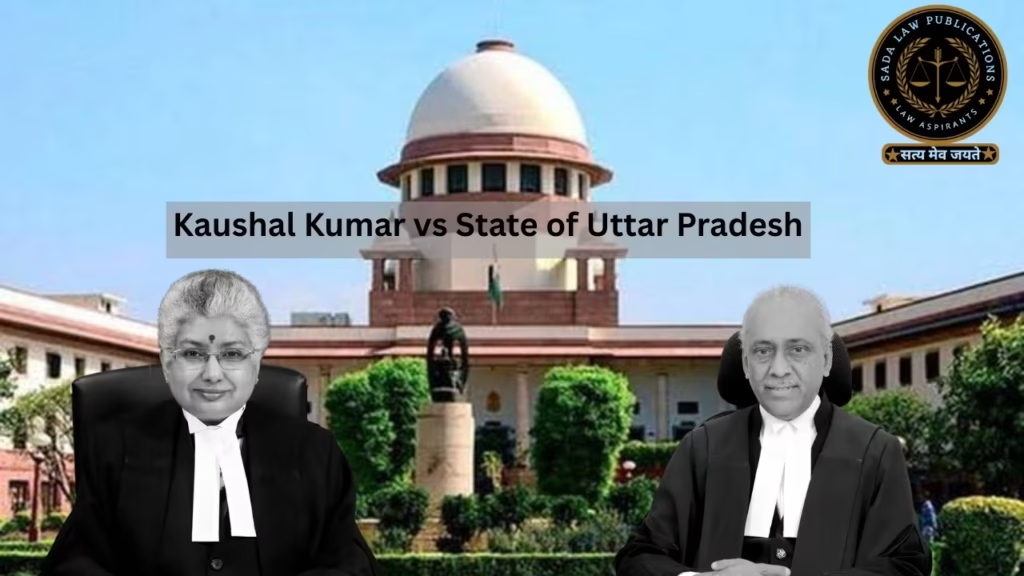
Kaushal Kumar vs State of Uttar Pradesh: Supreme Court’s Landmark Verdict on Free Speech and Right to Dignity

Trending Today Kaushal Kumar vs State of Uttar Pradesh: Supreme Court’s Landmark Verdict on Free Speech and Right to Dignity Pakistan’s Defence Minister Admits Terror Support, Blames India for Pahalgam Attack Amid Rising Tensions Punjab and Haryana High Court Rules on Husband’s Appeal for Divorce Amid Alleged Extramarital Affair Copyright Protection for Hindustani Classical Music Compositions and AR Rahman’s ‘Veera Raja Veera’ Dispute” Delhi High Court Suspends Medha Patkar’s Sentence in VK Saxena Defamation Case India Puts Indus Waters Treaty on Hold: Historic Decision Amid Rising Tensions with Pakistan Terrorist Attack in Pahalgam, Jammu & Kashmir: 26 Dead, Several Critically Injured in Market Shooting Raj Kundra Moves Bombay High Court to Quash Look Out Circular in Pornographic Film Racket Case Ramdev Agrees to Remove ‘Sharbat Jihad’ Videos After Court Rebuke Over Rooh Afza Remarks Deadly Terrorist Attack in Pahalgam, Kashmir: 28 Tourists Killed in Bloodiest Incident Since Article 370 Repeal Kaushal Kumar vs State of Uttar Pradesh: Supreme Court’s Landmark Verdict on Free Speech and Right to Dignity NITU KUMARI 26 Apr 2025 Explore the landmark Supreme Court of India judgment in Kaushal Kumar vs State of Uttar Pradesh, where the balance between free speech and the right to dignity was carefully examined. Understand its impact on Indian constitutional law and future legal interpretations. Introduction: A Landmark Ruling on Free Speech and Dignity In the pivotal case of Kaushal Kumar vs State of Uttar Pradesh (2023), the Supreme Court of India addressed a delicate constitutional dilemma: balancing the right to free expression with the right to dignity.Decided by Justices B.V. Nagarathna and V. Ramasubramanian, this judgment has lasting implications for India’s legal system and democracy. The Background of Kaushal Kumar’s Legal Battle The case arose from a speech made by a minister in Uttar Pradesh that contained remarks perceived as insulting towards a minority community.Kaushal Kumar, feeling deeply aggrieved, filed a complaint seeking to defend personal dignity against the misuse of freedom of speech. This was not just a personal legal fight but a broader call to protect individual dignity in democratic discourse.The journey to the Supreme Court became a test of constitutional values and evolving societal norms, challenging the judiciary to define the boundaries of fundamental rights. Key Legal Issues Before the Supreme Court The Core Question: Freedom of Speech vs Right to Dignity At the heart of the case was a vital constitutional query:Where does the right to free expression end, and the right to dignity begin? The Court faced the complex task of ensuring that the freedom to express opinions does not overshadow the fundamental respect owed to every citizen. Recognizing that both rights are essential strands of the Indian Constitution, the Court emphasized that freedom of speech must coexist with the obligation to respect human dignity. Supreme Court’s Verdict: Balancing Rights with Responsibility In a nuanced decision, the Supreme Court ruled that while free speech is a cornerstone of democracy, it carries with it a corresponding responsibility. The Court found that the minister’s remarks crossed the line of legitimate discourse and violated the petitioner’s inherent right to dignity. By reinforcing that expression must be tempered with empathy and respect, the Court set a crucial precedent:Freedom of speech is not an absolute license and must not infringe on another’s self-worth. The Right to Dignity: A Fundamental Constitutional Value The Court’s analysis highlighted that dignity, although not explicitly mentioned in the Constitution, is deeply embedded within the rights to life and personal liberty under Article 21. It asserted that dignity involves more than just physical well-being — it encompasses respect for one’s identity, self-worth, and equality in all spheres of life. This ruling strengthens the constitutional fabric by emphasizing that safeguarding dignity is essential for nurturing a just, equitable, and democratic society. Impact on Future Jurisprudence The Kaushal Kumar judgment is set to become a guiding light for future cases where freedom of speech and dignity intersect. Courts across India are likely to refer to this precedent when addressing disputes involving personal insult, hate speech, or defamation. Moreover, the ruling urges policymakers, scholars, and citizens to promote a culture of respectful dialogue while preserving the vibrancy of free speech. Public Reaction and Scholarly Analysis The judgment has ignited passionate discussions among human rights activists, legal scholars, and free speech advocates. While many hail it as a milestone for protecting human dignity, others express concern about its potential chilling effect on free expression. Nevertheless, the debate it sparked underscores its significance in shaping future legal discourse and societal values. Conclusion: A New Chapter in India’s Constitutional Journey The Supreme Court’s decision in Kaushal Kumar vs State of Uttar Pradesh reaffirms India’s commitment to both freedom and fairness.It stands as a testament to the judiciary’s role in carefully balancing competing rights and guiding society towards respectful coexistence. As citizens and legal enthusiasts, staying informed about such landmark rulings enriches our understanding of India’s evolving democratic values. Watch and Learn More 🎥 Watch the detailed video on the Kaushal Kumar Case References Kaushal Kumar vs State of Uttar Pradesh Case Summary – iPleaders Justice System and Rule of Law – Gray Group Intl Commitment to Rule of Law – Faster Capital Safeguarding Justice and Upholding Rule of Law – Legal Service India Leave a Reply Cancel Reply Logged in as Sadalaw Publications. Edit your profile. Log out? Required fields are marked * Message* Case Laws Kaushal Kumar vs State of Uttar Pradesh: Supreme Court’s Landmark Verdict on Free Speech and Right to Dignity Kaushal Kumar vs State of Uttar Pradesh: Supreme Court’s Landmark Verdict on Free Speech and Right to Dignity Sadalaw Publications • April 26, 2025 • Case law • No Comments Supreme Court Directs Policy Reform in Mining Royalty: Kirloskar Ferrous Industries Ltd. v. Union of India Explained Supreme Court Directs Policy Reform in Mining Royalty: Kirloskar Ferrous Industries Ltd. v. Union of India Explained Sadalaw Publications • April 18, 2025 • Case law • No Comments Supreme Court Verdict on Same-Sex Marriage in India: Supriyo vs Union

Kaushal Kumar vs State of Uttar Pradesh: Supreme Court’s Landmark Verdict on Free Speech and Right to Dignity Read More »

Supreme Court Judges Publicly Declare Assets: A Historic Move Toward Judicial Transparency in India

Trending Today Supreme Court Judges Publicly Declare Assets: A Historic Move Toward Judicial Transparency in India Supreme Court Halts Nashik Dargah Demolition, Questions Bombay High Court Over Plea Listing Delay Wildlife Conservation Laws in India: Legal Framework, Importance & Key Acts “Drone Usage in India: Laws, Regulations, and the Future of UAV Technology” RCB vs Uber Trademark Dispute: Delhi High Court Case Over Viral Travis Head YouTube Ad Supreme Court Directs Policy Reform in Mining Royalty: Kirloskar Ferrous Industries Ltd. v. Union of India Explained Supreme Court Orders Immediate License Suspension for Hospitals Involved in Baby Trafficking National Herald Case: ED Files ₹2,000 Crore Money Laundering Complaint Against Sonia and Rahul Gandhi Supreme Court Reviews Waqf Amendment Act 2025: Questions Muslim Role in Hindu Trusts Supreme Court Upholds Validity of IPC Section 498A, Rejects Misuse Claims Under Article 14 Supreme Court Judges Publicly Declare Assets: A Historic Move Toward Judicial Transparency in India MAHI SINHA 20 Apr 2025 Introduction: A Landmark Moment for Indian Judiciary In a time when public trust in institutions is under scrutiny, the Supreme Court of India has taken a historic step to strengthen judicial transparency and accountability. On April 1, 2025, during a full-court meeting, all Supreme Court judges unanimously agreed to declare their personal assets publicly—a move that is already earning widespread praise. Why This Decision Is a Big Deal   Breaking the Norms of Secrecy While civil servants and politicians in India are routinely required to disclose their assets, the higher judiciary has traditionally remained exempt. The Supreme Court’s decision to change that narrative breaks long-standing norms and signals a new era of openness. A Message of Integrity and Accountability By voluntarily sharing their assets, Supreme Court judges are making a strong statement of integrity. They are showing the nation that justice must not only be done but must also be seen to be done—by those who deliver it. What This Means for the Public   Rebuilding Public Trust in the Judiciary In a country where concerns over corruption and misuse of power often dominate headlines, this decision serves as a powerful tool to rebuild public confidence. Citizens now have an opportunity to see that the judiciary is willing to hold itself to the same standards of honesty, fairness, and transparency that it expects from others. Aligning With Global Standards Globally, judicial transparency is a key element of a trustworthy legal system. By taking this initiative, India’s Supreme Court joins a growing number of judiciaries around the world that are working to become more transparent and accountable to the people they serve. Final Thoughts: A Statement, Not Just a Step This is not merely a procedural change—it’s a symbolic and transformative statement. The Supreme Court judges’ decision to disclose their assets could mark the beginning of a wider cultural shift in Indian governance, where transparency becomes the norm, not the exception. Leave a Reply Cancel Reply Logged in as Sadalaw Publications. Edit your profile. Log out? Required fields are marked * Message* Live Cases Supreme Court Judges Publicly Declare Assets: A Historic Move Toward Judicial Transparency in India Supreme Court Judges Publicly Declare Assets: A Historic Move Toward Judicial Transparency in India Sadalaw Publications • April 20, 2025 • Live cases • No Comments Supreme Court Halts Nashik Dargah Demolition, Questions Bombay High Court Over Plea Listing Delay Supreme Court Halts Nashik Dargah Demolition, Questions Bombay High Court Over Plea Listing Delay Sadalaw Publications • April 19, 2025 • Live cases • No Comments RCB vs Uber Trademark Dispute: Delhi High Court Case Over Viral Travis Head YouTube Ad RCB vs Uber Trademark Dispute: Delhi High Court Case Over Viral Travis Head YouTube Ad Sadalaw Publications • April 18, 2025 • Live cases • No Comments 1 2 3 … 5 Next »

Supreme Court Judges Publicly Declare Assets: A Historic Move Toward Judicial Transparency in India Read More »

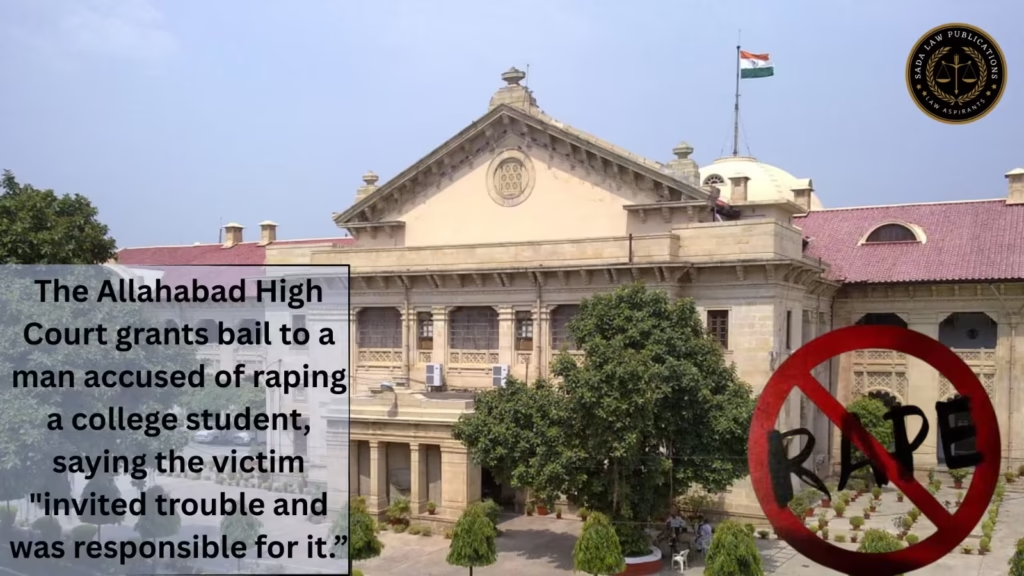
Allahabad High Court Sparks Outrage by Granting Bail in Rape Case, Blaming Victim for Her Actions

Trending Today Allahabad High Court Sparks Outrage by Granting Bail in Rape Case, Blaming Victim for Her Actions Supreme Court Orders AIIMS to Reassess MBBS Eligibility of PwBD Candidate Based on Om Rathod and Anmol Rulings Misuse of Section 17B of the Industrial Disputes Act: Challenges for Employers and Legal Loopholes Supreme Court Strikes Down Tamil Nadu Rule Requiring Title Proof for Property Registration Delhi High Court Fines Shazia Ilmi ₹25,000 in Privacy Violation Case Against Rajdeep Sardesai India and Nepal Sign MoU to Strengthen Judicial Cooperation and Legal Exchange Calcutta High Court Allows Anjani Putra Sena’s Ram Navami Rally in Howrah with Strict Conditions Waqf Amendment Bill Sparks Uproar: Opposition Moves Supreme Court Over Alleged Bias Against Muslims “NALSA Files PIL for Humanitarian Release of Aged and Sick Inmates from Indian Jails” Which law states that Aadhaar is required to operate bank accounts? Questions for the Supreme Court the Delhi government’s refusal to grant workers’ allowances Allahabad High Court Sparks Outrage by Granting Bail in Rape Case, Blaming Victim for Her Actions MAHI SINHA 11 Apr 2025 The victim ‘herself wanted difficulty‘ and was ‘responsible‘ for the alleged act of rape, according to the Allahabad High Court, which recently granted bail to a man accused of raping a college student. The victim said that after agreeing to go to his relative’s apartment to rest because she was extremely drunk and in need of assistance after drinking, the accused, whom she had met at a club, had sexually assaulted her twice in his apartment. This court believes that even if the victim’s claim is believed to be accurate, it can still be said that she caused the problem by inviting it and being accountable for it. In her statement, the victim has taken a similar stance. A bench of Justice Sanjay Kumar Singh noted that although her hymen was found torn during her medical test, the doctor did not express any view regarding the sexual assault while granting the accused’s bail request. The bench further stated that the victim was competent enough to comprehend the “morality” and relevance of her act as revealed by her in the F.I.R. because she was an MA student. In essence, according to the victim’s account, she went to a Delhi bar on her own initiative with three female friends, where they drank alcohol, which caused her to become inebriated. She added that the accused insisted she go to his house with him while she was there, and she stayed at the pub until about three in the morning. She consented to accompany him to relax because she needed assistance because of her condition. She further claimed that the accused had inappropriately touched her while traveling and that, rather than taking her to his home in Noida as she had anticipated, he had taken her to a relative’s apartment in Gurgaon, where he raped her. The accused petitioned the HC for bail in the case, and his attorney contended that even if all the accusations are believed to be accurate, the case is not one of rape but rather one of a mutually agreeable connection between the parties. The suspect has been detained since December 2024 and has no criminal record, according to the argument, and if he is released on bail, he will cooperate in the early resolution of the case and not abuse his freedom. In contrast, the Additional Government Advocate for the State opposed the applicant’s bail request in light of the FIR, but he did contest the aforementioned factual aspect of the case as argued by the applicant. In light of these arguments, the court granted him bail, noting: Taking into account the case’s facts and circumstances, the nature of the offense, the evidence, the accused’s complicity, and the arguments made by the parties’ knowledgeable attorneys, I believe the applicant has established a strong case for bail. Therefore, the application for bail is granted. Leave a Reply Cancel Reply Logged in as sadalawpublications@gmail.com. Edit your profile. Log out? Required fields are marked * Message* Live Cases Allahabad High Court Sparks Outrage by Granting Bail in Rape Case, Blaming Victim for Her Actions Allahabad High Court Sparks Outrage by Granting Bail in Rape Case, Blaming Victim for Her Actions sadalawpublications@gmail.com • April 11, 2025 • Live cases • No Comments Supreme Court Orders AIIMS to Reassess MBBS Eligibility of PwBD Candidate Based on Om Rathod and Anmol Rulings Supreme Court Orders AIIMS to Reassess MBBS Eligibility of PwBD Candidate Based on Om Rathod and Anmol Rulings sadalawpublications@gmail.com • April 9, 2025 • Live cases • No Comments Supreme Court Strikes Down Tamil Nadu Rule Requiring Title Proof for Property Registration Supreme Court Strikes Down Tamil Nadu Rule Requiring Title Proof for Property Registration sadalawpublications@gmail.com • April 8, 2025 • Live cases • No Comments 1 2 3 … 5 Next »

Allahabad High Court Sparks Outrage by Granting Bail in Rape Case, Blaming Victim for Her Actions Read More »