
sadalawpublications.com

waqf property

AIMPLB Challenges WAQF Amendment Act 2025: Supreme Court Affidavit Highlights Risks of De-registration

Trending Today AIMPLB Challenges WAQF Amendment Act 2025: Supreme Court Affidavit Highlights Risks of De-registration Supreme Court: Bribery Conviction Under PC Act Requires Proof of Demand Beyond Recovery of Tainted Notes Supreme Court Clarifies Modification Powers Under Arbitration Act in Landmark Ruling Supreme Court to Review Vijay Madanlal Choudhary Ruling on PMLA: Hearing Scheduled for May 7 Supreme Court Upholds LGBTQ+ Autonomy in Habeas Corpus Case: Guidelines Issued to High Courts Supreme Court Overturns Remission in Bilkis Bano Case: 2002 Gujarat Riots Convicts Ordered Back to Jail Supreme Court Grants Chhattisgarh State Option to Seek Case Transfer Amid Heated Liquor Scam Hearing Byju’s Withdraws Supreme Court Petition on Aakash Ownership: Karnataka HC Ruling Stands Supreme Court Affirms Group of Companies Doctrine: Non-Signatories Can Be Bound by Arbitration Agreements Punjab & Haryana High Court Orders Removal of Unauthorized Gurudwara and Temple in Kharar AIMPLB Challenges Waqf Amendment Act 2025: Supreme Court Affidavit Highlights Risks of Deregistration MAHI SINHA 04 May 2025 Discover AIMPLB’s objections to the Waqf (Amendment) Act, 2025, and its implications for waqf properties in India. Learn about the constitutional and legal challenges raised in the Supreme Court. AIMPLB Opposes Waqf Registration Requirement The All India Muslim Personal Law Board (AIMPLB), through its General Secretary Mohammed Fazlurrahim, has raised concerns over the Waqf (Amendment) Act, 2025. In its affidavit, AIMPLB challenges the Union Government’s claim that the new requirement for waqf registration is harmless and asserts that it undermines the legal recognition of waqfs-by-user. Context of the Case The Supreme Court is set to hear the case on May 5, 2025, before a bench comprising Justices Sanjiv Khanna, Sanjay Kumar, and K. V. Viswanathan. The AIMPLB’s affidavit refutes the government’s position that historical waqf properties registered before April 8, 2025, remain unaffected by the amendment. The Union claims that registration only involves submitting basic information without requiring documentation. Key Objections by AIMPLB 1. Legal Validity of Waqfs-by-User AIMPLB contends that the revised Section 3(r) of the Act effectively derecognizes waqfs-by-user unless registered. This violates the principle of non-retrogression upheld in landmark cases like Navtej Singh Johar v. Union of India. AIMPLB argues that waqfs have existed for centuries without registration being a prerequisite. 2. Historical Perspective The Board asserts that waqf registration has never been a requirement for its creation, citing the Mussalman Wakf Act of 1923. In Mohammed Ghouse v. Karnataka Board of Wakfs, the courts rejected claims that registration was necessary for waqf validity. 3. Discriminatory Implications AIMPLB argues that the amendment discriminates between registered and unregistered waqfs. This contradicts the intent of previous waqf regulations, including the Waqf Act of 1995, which emphasized recognition without making registration mandatory. Challenges to Government Claims AIMPLB highlights inconsistencies in the Union’s counter-affidavit. The government’s acknowledgment of “removing statutory protection to waqfs-by-user” is contradictory to its subsequent denial of such implications. The Board emphasizes that non-registration should not invalidate waqfs, as historically, only the mutawalli’s failure to register has attracted penalties. Constitutional Concerns The amendment’s prospective application does not address the broader implications for user-recognized waqfs. AIMPLB argues that: The removal of waqfs-by-user’s recognition violates Article 26 of the Constitution of India. Section 36(7A) enables government claims to supersede waqf registration, further jeopardizing waqf properties. Conclusion AIMPLB maintains that the Waqf (Amendment) Act undermines the historical and legal foundation of waqfs in India. It asserts that registration should not be a precondition for waqf recognition and calls for the Court to address the discriminatory and unconstitutional aspects of the amendment. Leave a Reply Cancel Reply Logged in as Sada Law. Edit your profile. Log out? Required fields are marked * Message* Live Cases AIMPLB Challenges WAQF Amendment Act 2025: Supreme Court Affidavit Highlights Risks of De-registration AIMPLB Challenges WAQF Amendment Act 2025: Supreme Court Affidavit Highlights Risks of De-registration Sada Law • May 4, 2025 • Live cases • No Comments Supreme Court: Bribery Conviction Under PC Act Requires Proof of Demand Beyond Recovery of Tainted Notes Supreme Court: Bribery Conviction Under PC Act Requires Proof of Demand Beyond Recovery of Tainted Notes Sada Law • May 4, 2025 • Live cases • No Comments Supreme Court Clarifies Modification Powers Under Arbitration Act in Landmark Ruling Supreme Court Clarifies Modification Powers Under Arbitration Act in Landmark Ruling Sada Law • May 4, 2025 • Live cases • No Comments 1 2 3 … 5 Next »
AIMPLB Challenges WAQF Amendment Act 2025: Supreme Court Affidavit Highlights Risks of De-registration Read More »

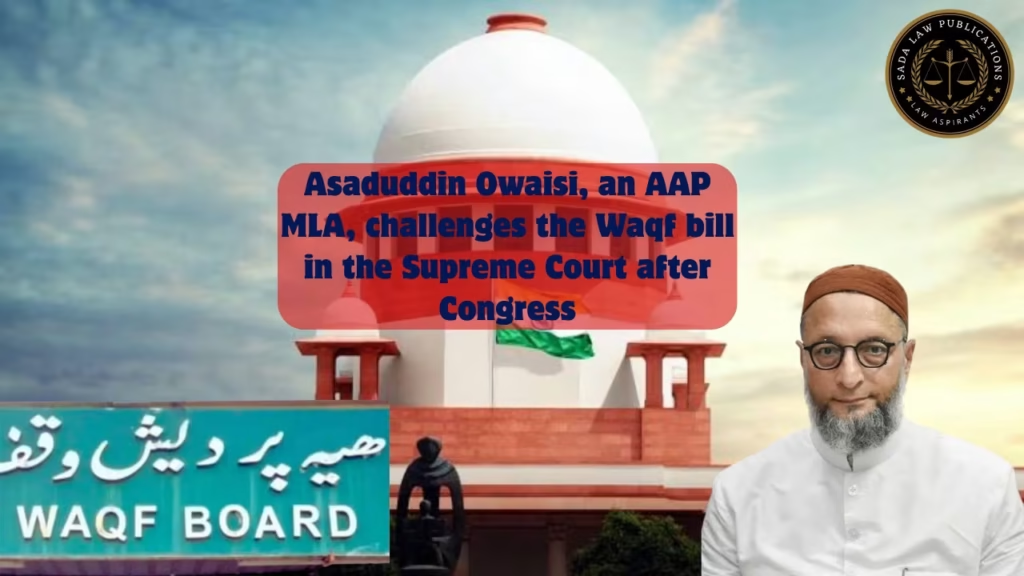
Waqf Amendment Bill Sparks Uproar: Opposition Moves Supreme Court Over Alleged Bias Against Muslims

Trending Today Waqf Amendment Bill Sparks Uproar: Opposition Moves Supreme Court Over Alleged Bias Against Muslims “NALSA Files PIL for Humanitarian Release of Aged and Sick Inmates from Indian Jails” Which law states that Aadhaar is required to operate bank accounts? Questions for the Supreme Court the Delhi government’s refusal to grant workers’ allowances Opening the Monument Examining the Long-Term Effects of the 1981 Case Francis Coralie v. Union Territory of Delhi on Individual Liberty and Indian Jurisprudence Rajya Sabha Adopts Bill 2025 for Waqf (Amendment) Destruction in Kancha Gachibowli ‘forest’ area depicts an ‘alarming picture’, says SC NCLT Rejects Insolvency Plea Against Zomato Over Payment Dispute Actor Hansika Motwani files a motion in the Bombay High Court to quash a FIR after being booked in a Section 498A case. Supreme Court slams Telangana CM for “making mockery” of anti-defection law Union Minister Kiren Rijiju: The Waqf Amendment Bill Is Prospective Rather Than Retrospective Waqf Amendment Bill Sparks Uproar: Opposition Moves Supreme Court Over Alleged Bias Against Muslims MAHI SINHA 07 Apr 2025 The opposition parties are concerned about the Waqf Amendment Bill, which aims to change the 1995 law controlling Waqf properties. New Delhi: As the contentious Waqf Amendment Bill seeks the President‘s approval after passing both Houses of Parliament, the Aam Aadmi Party (AAP) has joined the Congress and Asaduddin Owaisi‘s AIMIM as the third major opposition party to take on the bill in the Supreme Court. Opposition parties contend that the proposed legislation, which aims to modify the 1995 law managing Waqf properties, is biased and threatens Muslims. AAP MLA Amanatullah Khan said in his plea that the government’s intervention violates minorities’ rights to run own institutions and that the amendment will diminish Muslims’ religious autonomy. Nonetheless, the government has insisted that the measure will help Muslim women and guarantee openness in the administration of Waqf properties. Mr. Khan contested the Waqf Amendment Bill’s constitutionality, claiming that it infringes upon multiple basic liberties of citizens, such as the freedom of equality, the management of religious matters, and the rights of minorities. He said that the measure violates minorities’ rights to run their religious and philanthropic organizations, restricts Muslims’ religious and cultural autonomy, and permits capricious presidential intervention. His suit comes after two other opposition MPs, Asaduddin Owaisi and Mohammad Jawed, of the Congress, filed identical objections. The law prejudices against Muslims by enforcing limits that are absent from the governance of other religious institutions, according to Mr. Jawed, a member of the joint parliamentary commission on the Waqf bill. The law’s provision allowing non-Muslims to serve on state boards and Waqf councils is one of the main points of contention. According to Mr. Owaisi, this is a serious constitutional infringement and isn’t the instance with the Hindu Endowment Board or the Jain Endowment Board. Speaking to NDTV yesterday, Mr. Owaisi claimed that the BJP is utilizing the vast majority in parliament to wage a war on Muslims by passing legislation that will ruin and take away all of their rights rather than reforms. BJP MP Ravi Shankar Prasad defended the bill, telling NDTV that it will increase transparency by holding Waqf boards responsible. He made it clear that no mosque or cemetery will be impacted in an effort to dispel concerns that the measure would seize Waqf sites. After a contentious debate between the opposition and treasury benches, the Lok Sabha passed the Waqf bill Thursday morning by 288 votes to 232. The Rajya Sabha then passed it with 128 votes in favor and 95 against. Following Friday’s weekly prayers, the bill’s approval triggered massive demonstrations in cities including Ahmedabad, Chennai, and Kolkata. Leave a Reply Cancel Reply Logged in as sadalawpublications@gmail.com. Edit your profile. Log out? Required fields are marked * Message* Live Cases Waqf Amendment Bill Sparks Uproar: Opposition Moves Supreme Court Over Alleged Bias Against Muslims Waqf Amendment Bill Sparks Uproar: Opposition Moves Supreme Court Over Alleged Bias Against Muslims sadalawpublications@gmail.com • April 7, 2025 • Live cases • No Comments “NALSA Files PIL for Humanitarian Release of Aged and Sick Inmates from Indian Jails” “NALSA Files PIL for Humanitarian Release of Aged and Sick Inmates from Indian Jails” sadalawpublications@gmail.com • April 6, 2025 • Live cases • 1 Comment Which law states that Aadhaar is required to operate bank accounts? Questions for the Supreme Court the Delhi government’s refusal to grant workers’ allowances Which law states that Aadhaar is required to operate bank accounts? Questions for the Supreme Court the Delhi government’s refusal to grant workers’ allowances sadalawpublications@gmail.com • April 5, 2025 • Live cases • No Comments 1 2 3 … 5 Next »

Waqf Amendment Bill Sparks Uproar: Opposition Moves Supreme Court Over Alleged Bias Against Muslims Read More »

Rajya Sabha Adopts Bill 2025 for Waqf (Amendment)

Trending Today Rajya Sabha Adopts Bill 2025 for Waqf (Amendment) Destruction in Kancha Gachibowli ‘forest’ area depicts an ‘alarming picture’, says SC NCLT Rejects Insolvency Plea Against Zomato Over Payment Dispute Actor Hansika Motwani files a motion in the Bombay High Court to quash a FIR after being booked in a Section 498A case. Supreme Court slams Telangana CM for “making mockery” of anti-defection law Union Minister Kiren Rijiju: The Waqf Amendment Bill Is Prospective Rather Than Retrospective Supreme Court of India Significance of mitigating factors when awarding the death penalty. The Supreme Court permits the petitioner to get involved in ongoing proceedings but rejects another petition contesting the Places of Worship Act. Punjab & Haryana High Court: Child in Womb During Accident Is Subject To Reimbursement Under MV Act What it implies signifies Sam Altman claims that OpenAI’s GPUs are “melting” over Ghibli-style AI art Rajya Sabha Adopts Bill 2025 for Waqf (Amendment) MAHI SINHA 05 Apr 2025 Update: 04 Apr 2025 After a discussion that lasted more than 14 hours, the Rajya Sabha enacted the Waqf (Amendment) Act, 2025 at around 2.22 AM on April 4, after midnight. The law received 128 votes in favor and 95 votes against it. Abstention did not exist. On April 3, the Lok Sabha approved the bill. It is currently awaiting the President of India‘s approval to become legislation. Waqf is a person’s ongoing commitment to any cause that is accepted by Muslim law as benevolent, religious, or pious. On August 8 of last year, the Waqf (Amendment) Bill, 2024 was presented to the Lok Sabha. In order to modernize waqf administration, lower litigation, and guarantee the effective management of waqf holdings, some 40 revisions were recommended to the current Waqf Act, 1995 (as revised in 2013). It was turned over to the Joint Parliamentary Committee (JPC) for a more thorough examination of the suggested modifications following strong opposition criticism. With certain modifications, the Bill has essentially been approved by the JPC. The government and its members made it clear during the discussion on Thursday that the Act aims to guarantee efficient administration of waqf property in order to guarantee that the money received from waqf is distributed fairly for the benefit of Muslims. Kiren Rijiju explained that the user’s provide of waqf is prospective in nature and said that the Government has adopted some of the JPC’s recommendations. Amit Shah of the Ministry of Home Affairs also provided clarification on this. Shah made sure that no one would meddle in Muslims’ religious matters. The Bill seeks to increase efficiency, accountability, and openness, Rijiju noted today. The Waqf Board is only a legal entity, plain and simple, and not an autonomous body of the Muslim body, according to the Kerala High Court‘s ruling in “Syed Fazal Pookoya Thangal vs. Union of India And Ors,” which he referenced. Rijiju defended the choice to include two non-Muslim members, saying that the government has no intention of meddling in religious matters and only wants to make the ruling party more secular. Hazif Mohd Zafar Ahmd v. UP Central Sunni Board of Waqf, another Allahabad High Court ruling that noted that Mutawalli’s function is secular and not a religious ritual, was also mentioned by Rijiju. The federal government guided the 2013 modification introduced during the Indian National Congress‘s longevity,” said House Leader JP Nadda today. However, the government discovered in 2020–21 that the waqf property had only grown by 18 lac hectares between 1913 and 2013, while 21 lac hectares of waqf assets were added between 2013 and 2025. The government introduced this bill to make sure it wasn’t abused. Nadda said that because the 2013 amendment gave the waqf board exceptional powers, it seemed to override the nation’s constitutional structure. He said that it turned into a harsh legislation. He cited Section 40 of the Parent Act in particular, stating that the Waqf Board has the authority to determine whether a property qualified as a waqf asset on its own. Additionally, he cited the clause that prohibited residents from contesting the waqf tribunal’s ruling in ordinary courts, claiming that this was against Article 21. Additionally, Section 54 was cited, which, in Nadda’s opinion, permitted the Tribunal’s decision to remove the encroachment. In contrast, civil courts were prohibited from pursuing any legal action under Sections 5 and 6 of the Parent Act. The Leader of the Opposition, Mallikarjun Kharge, queried why, if the government wants the wellbeing of Muslims, it has halted five programs that assist them. Additionally, he stated that the Ministry of Minority Affairs funding is still being cut by the governing body. Kharge noted that the Government initially granted the Collector jurisdiction and then transferred that authority to a designated State official above the Collector’s legitimacy, rather than the Survey Inspector doing an initial investigation into the waqf land. The opponents claimed that the government was attempting to split the populace along religious lines and criticized the bill for breaching Article 25 of the Constitution. A few members also had concerns about how the JPC operated. According to Dr. Syed Naseer Hussain, the government welcomed non-stakeholders for the first time today since they were aware that the vast majority of people opposed the proposal. According to Dr. Abhishek Manu Singhvi, the Bill blatantly disregards Articles 25 and 26 of the Constitution. He went on to say that he has participated in some important cases, including those involving the Sabarimala temple and the Dawoodi Bohra community, and in these rulings, the Supreme Court has unequivocally declared that a custom or execute fully falls under the safeguards of fundamental rights provided by Articles 25 and 26 once it is deemed a necessary part of religion. Singhvi cited Ratilal Panachand Gandhi v. State of Bombay, saying that a statute that completely removes a religious denomination’s administrative power and transfers it to a different, more secular body would violate Article 26 rights. Singhvi of Tilkayat Shri Govindlalji Maharaj vs. The State of Rajasthan also cited this

Rajya Sabha Adopts Bill 2025 for Waqf (Amendment) Read More »