
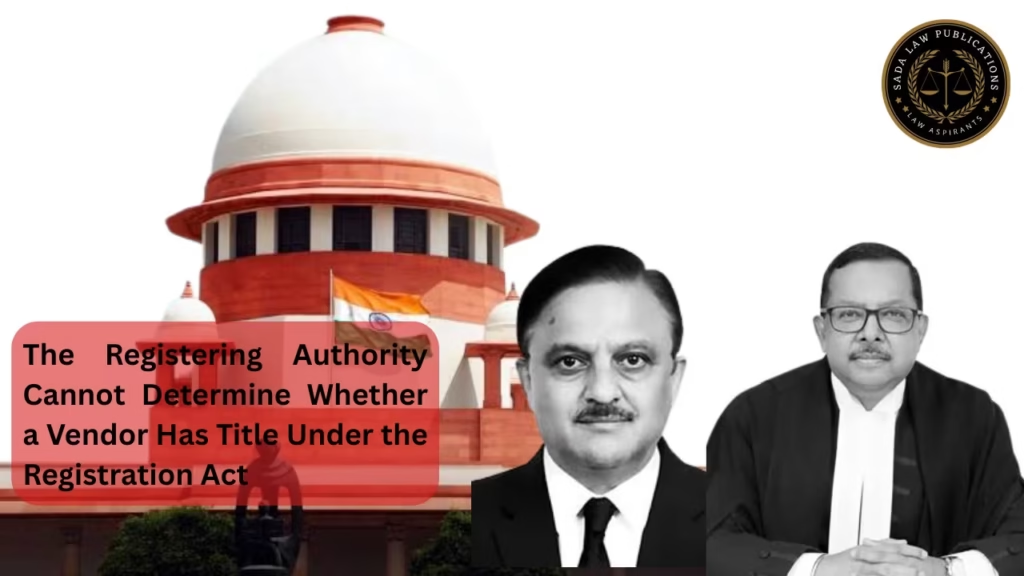
Supreme Court Strikes Down Tamil Nadu Rule Requiring Title Proof for Property Registration
Trending Today Supreme Court Strikes Down Tamil Nadu Rule Requiring Title Proof for Property Registration Delhi High Court Fines Shazia Ilmi ₹25,000 in Privacy Violation Case Against Rajdeep Sardesai India and Nepal Sign MoU to Strengthen Judicial Cooperation and Legal Exchange Calcutta High Court Allows Anjani Putra Sena’s Ram Navami Rally in Howrah with Strict Conditions Waqf Amendment Bill Sparks Uproar: Opposition Moves Supreme Court Over Alleged Bias Against Muslims “NALSA Files PIL for Humanitarian Release of Aged and Sick Inmates from Indian Jails” Which law states that Aadhaar is required to operate bank accounts? Questions for the Supreme Court the Delhi government’s refusal to grant workers’ allowances Opening the Monument Examining the Long-Term Effects of the 1981 Case Francis Coralie v. Union Territory of Delhi on Individual Liberty and Indian Jurisprudence Rajya Sabha Adopts Bill 2025 for Waqf (Amendment) Destruction in Kancha Gachibowli ‘forest’ area depicts an ‘alarming picture’, says SC Supreme Court Strikes Down Tamil Nadu Rule Requiring Title Proof for Property Registration MAHI SINHA 08 Apr 2025 It is not possible to deny the deed’s registration on the grounds that the executant lacks title to the property being transferred. The Supreme Court noted that the Registering Authority cannot refuse registration of a transfer deed on the grounds that the vendor’s title documents are either untested or not presented, as permitted under the Registration Act of 1908. Because Rule 55A(i) of the Tamil Nadu Registration Rules conflicted with the regulations of the Registration Act of 1908, the Court declared it to be unconstitutional. As per Rule 55A(i), the person seeking registration of a document was mandated to produce the previous original deed as per which he acquired title and encumbrance certificate. Unless this Rule is complied with, the document will not be registered. A bench comprising Justice Abhay S Oka and Justice Ujjal Bhuyan struck down this rule saying that it was not within the mandate of the Sub-Registrar or Registering Authority under the 1908 Act to verify whether the vendor has valid title. Even if a person executing a sale deed or lease does not have title to the property, the registering authority cannot refuse to register the document, provided all procedural requirements are met and applicable stamp duty and registration fees are paid. The Court observed that none of the provisions in Clauses (a) through (j) of Section 69 of the Registration Act give the registering authority the ability to refuse to register a document of transfer through the setting of rules. The Court noted that no clause in the 1908 Act gives any body the right to deny certification of a transfer document on the grounds that the vendor’s title is not proved or that no documentation pertaining to it is presented. Judicial analysis: The executant’s title is of little relevance to the registration officer. He lacks the adjudicatory authority to determine if the executant is entitled to anything. The registering officer cannot refuse to register a sale deed or lease executed by an executant for land over which he has no title, provided that all formalities are followed and the required stamp duty and registration fee are paid. It should be noted that the Sub-Registrar or Registering Authority is not responsible for determining whether the vendor is the legal owner of the property he is attempting to transfer under the terms of the 1908 Act. The document must be registered after the registering authority is satisfied that the parties are present and that they have admitted to executing it in front of him, provided that they have complied with the previously described procedural requirements. Only the rights, if any, that belong to the executant are transferred when a document is executed and registered. “The registered document cannot effect any transfer if the executant has no right, title, or interest in the property.” The Court ruled that Rule 55A(i) is ultra vires the parent Act, pointing out that it is in conflict with the Registration Act. To provide some background information, the petitioner presented a sale deed document to the relevant Sub-Registrar in order to register a property in his name, asserting title based on an unreported will. The Sub-Registrar, however, declined to register the aforementioned document, claiming that the petitioner had failed to prove his ownership and title as required by Rule 55A and that the document did not name the vendor’s rightful heirs. The petitioner, enraged, went to the Madras High Court and filed a writ suit. He went to the Supreme Court after failing before the High Court. In related news, the Madras High Court just ruled that Rule 55A was simply put in place to give Registrars the ability to arbitrarily refuse to register instruments; it has no statutory validity. Leave a Reply Cancel Reply Logged in as sadalawpublications@gmail.com. Edit your profile. Log out? Required fields are marked * Message* Live Cases Supreme Court Strikes Down Tamil Nadu Rule Requiring Title Proof for Property Registration Supreme Court Strikes Down Tamil Nadu Rule Requiring Title Proof for Property Registration sadalawpublications@gmail.com • April 8, 2025 • Live cases • No Comments Delhi High Court Fines Shazia Ilmi ₹25,000 in Privacy Violation Case Against Rajdeep Sardesai Delhi High Court Fines Shazia Ilmi ₹25,000 in Privacy Violation Case Against Rajdeep Sardesai sadalawpublications@gmail.com • April 8, 2025 • Live cases • No Comments India and Nepal Sign MoU to Strengthen Judicial Cooperation and Legal Exchange India and Nepal Sign MoU to Strengthen Judicial Cooperation and Legal Exchange sadalawpublications@gmail.com • April 8, 2025 • Live cases • No Comments 1 2 3 … 5 Next »