sadalawpublications.com

constitutional law

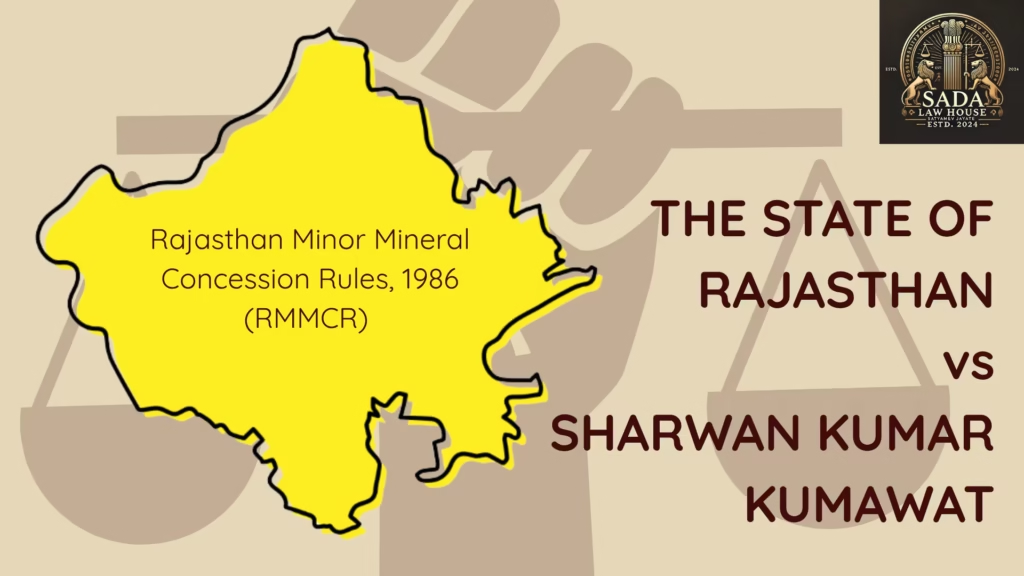
State of Rajasthan v. Sharwan Kumar Kumawat (2023): Constitutionality of Amendments to the Rajasthan Minor Mineral Concession Rules

Trending Today State of Rajasthan v. Sharwan Kumar Kumawat (2023): Constitutionality of Amendments to the Rajasthan Minor Mineral Concession Rules Application of the ESI Act to Pathological Labs: Endocrinology and Immunology Lab v. E.S.I. Corporation Supreme Court Orders Judicial and Investigative Oversight in Manipur Ethnic Violence Cases (2023 INSC 698) State of Rajasthan v. Sharwan Kumar Kumawat (2023): Validity of Amendments to Rajasthan Minor Mineral Concession Rules Endocrinology and Immunology Lab v. E.S.I. Corporation: Application of the ESI Act to Pathological Labs Dinganglung Gangmei vs Mutum Churamani Meetei (2023 INSC 698): Supreme Court Oversight in Manipur Ethnic Violence YUKTI: Nationwide Mentorship and Internship Initiative for Aspiring Lawyers Supreme Court Seeks Centre’s Response on Sonam Wangchuk’s Detention Saurabh Sharma Appointed Partner at JSA Advocates & Solicitors in Ahmedabad Salib @ Shalu @ Salim v. State of Uttar Pradesh & Ors. (2023) State of Rajasthan v. Sharwan Kumar Kumawat (2023): Constitutionality of Amendments to the Rajasthan Minor Mineral Concession Rules PRABHAT KUMAR BILTORIA 14 October, 2025 Introduction This case revolves around the legality and constitutionality of amendments made to the Rajasthan Minor Mineral Concession Rules, 1986 (RMMCR). The State of Rajasthan, through notifications issued in 2011 and 2013, replaced the earlier “first come, first served” system for granting mining leases with a delineation and auction-based system. The Rajasthan High Court struck down these amendments as unconstitutional, leading to an appeal before the Supreme Court. The Supreme Court’s judgment on August 1, 2023, clarified the extent of applicants’ rights and upheld the validity of the amended rules. Background (Facts of the Case) The State of Rajasthan issued notifications on January 28, 2011 and April 3, 2013, amending the RMMCR. Rule 4(10) and Rule 7(3) introduced a new framework mandating the delineation and auction of government land for mining leases. The amendments specified that all applications pending before January 27, 2011, would be rejected unless special circumstances justified consideration. These changes effectively ended the “first come, first served” practice, replacing it with a more transparent auction system. Applicants who had applied before the amendments, including Sharwan Kumar Kumawat, challenged the new rules. The Rajasthan High Court invalidated the amendments, citing: Violation of legitimate expectations of existing applicants, Absence of a hearing opportunity, and Infringement of alleged vested rights. Issue of the Case Whether the amendments to Rules 4(10) and 7(3) of the Rajasthan Minor Mineral Concession Rules, 1986 were constitutionally valid? Whether applicants for mining leases possess any fundamental or vested right in respect of their pending applications? Whether the amendments violated the principles of natural justice or legitimate expectation? Whether the amendments were introduced with malicious intent to circumvent previous court orders? Judgment The Supreme Court upheld the amendments and allowed the State’s appeal, setting aside the High Court’s decision. The major findings were as follows: 1. No Fundamental or Vested Right in Mining Merely submitting a mining lease application does not create a vested or enforceable right. There is no fundamental right to obtain a mining lease, as mineral resources are the property of the State and governed by statutory regulation. 2. Legitimacy of the Amendments The State has constitutional and statutory authority to modify rules to ensure transparency, fairness, and public interest. The shift to an auction-based mechanism was a policy decision aimed at better mineral regulation and equitable distribution of natural resources. 3. Natural Justice and Legitimate Expectation The doctrine of legitimate expectation cannot override public interest. Applicants do not have a right to be heard before the introduction of a new rule or policy. Amendments enacted for systemic improvement cannot be invalidated merely because they affect existing expectations. 4. No Legal Malice The amendments were part of a legitimate policy reform and not intended to nullify or evade earlier High Court orders. Previous rulings concerning specific sandstone mining cases in a few villages could not be generalized to all applicants statewide. 5. Precedent Support The Court relied on earlier decisions, including: State of Tamil Nadu v. Hind Stone (1981): No vested right arises from a pending mining application. Monnet Ispat & Energy Ltd. v. Union of India (2012): Mining rights are not fundamental rights. Kerala Beverages Corp. v. P.P. Suresh (2019): Public interest can limit legitimate expectations. Current Status The Supreme Court’s decision reinstated the validity of the 2011 and 2013 amendments, confirming that the auction and delineation system for granting mining leases in Rajasthan is lawful and constitutionally sound. All pending pre-2011 applications were rendered invalid unless covered by specific exceptions. Conclusion The Supreme Court reaffirmed that the State is the trustee of natural resources and that their allocation must be transparent, equitable, and in public interest. Applicants have no vested or fundamental right to a mining lease. The doctrine of legitimate expectation cannot override legislative policy reforms. The State’s amendments introducing the auction-based system were constitutionally valid and consistent with the principles of fairness, transparency, and good governance. This judgment strengthens the legal foundation for auction-based allocation of natural resources and affirms the supremacy of public interest in regulatory policymaking. Leave a Reply Cancel Reply Logged in as Sada Law. Edit your profile. Log out? Required fields are marked * Message* Case Laws State of Rajasthan v. Sharwan Kumar Kumawat (2023): Constitutionality of Amendments to the Rajasthan Minor Mineral Concession Rules Sada Law • October 14, 2025 • Case law • No Comments Application of the ESI Act to Pathological Labs: Endocrinology and Immunology Lab v. E.S.I. Corporation Sada Law • October 14, 2025 • Case law • No Comments Supreme Court Orders Judicial and Investigative Oversight in Manipur Ethnic Violence Cases (2023 INSC 698) Sada Law • October 14, 2025 • Case law • No Comments 1 2 3 … 5 Next »
State of Rajasthan v. Sharwan Kumar Kumawat (2023): Constitutionality of Amendments to the Rajasthan Minor Mineral Concession Rules Read More »

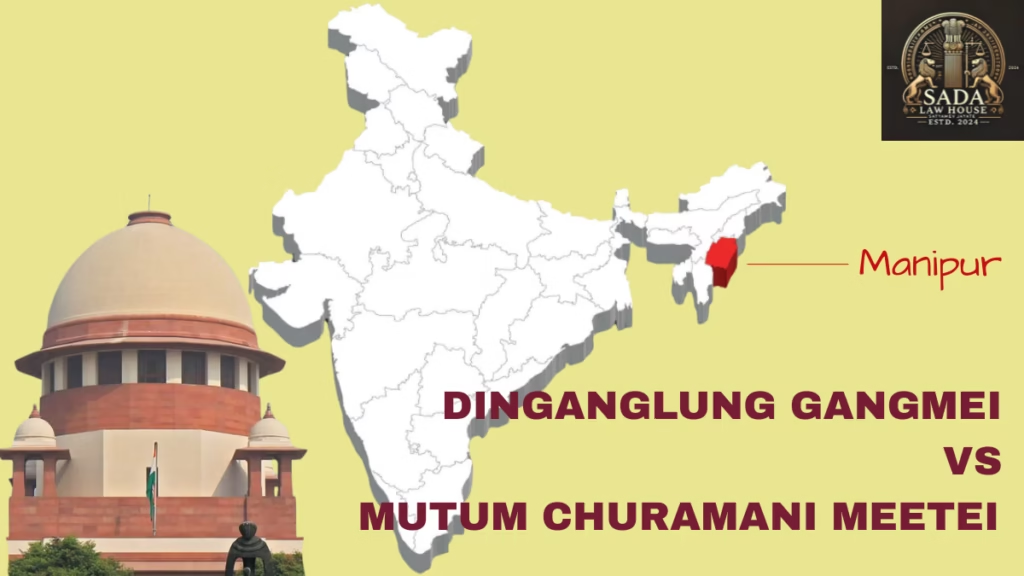
Supreme Court Orders Judicial and Investigative Oversight in Manipur Ethnic Violence Cases (2023 INSC 698)

Trending Today Supreme Court Orders Judicial and Investigative Oversight in Manipur Ethnic Violence Cases (2023 INSC 698) State of Rajasthan v. Sharwan Kumar Kumawat (2023): Validity of Amendments to Rajasthan Minor Mineral Concession Rules Endocrinology and Immunology Lab v. E.S.I. Corporation: Application of the ESI Act to Pathological Labs Dinganglung Gangmei vs Mutum Churamani Meetei (2023 INSC 698): Supreme Court Oversight in Manipur Ethnic Violence YUKTI: Nationwide Mentorship and Internship Initiative for Aspiring Lawyers Supreme Court Seeks Centre’s Response on Sonam Wangchuk’s Detention Saurabh Sharma Appointed Partner at JSA Advocates & Solicitors in Ahmedabad Salib @ Shalu @ Salim v. State of Uttar Pradesh & Ors. (2023) Kishore Balkrishna Nand v. State of Maharashtra & Anr (2023) Avtar Singh & Anr v. State of Punjab (2023) Supreme Court Orders Judicial and Investigative Oversight in Manipur Ethnic Violence Cases (2023 INSC 698) PRABHAT KUMAR BILTORIA 14 October, 2025 Introduction The case of Dinganglung Gangmei vs Mutum Churamani Meetei arose out of the severe ethnic violence in Manipur following the Manipur High Court’s directive to consider the Meitei community for inclusion in the Scheduled Tribes list. This led to large-scale unrest, human rights violations, and displacement. Petitions were filed under Article 32 of the Constitution seeking protection of victims’ rights, restoration of order, and judicial oversight in the investigation of crimes. Background On March 27, 2023, the Acting Chief Justice of the Manipur High Court instructed the state administration to recommend the inclusion of the Meitei community in the Scheduled Tribes list. This decision sparked widespread protests among tribal groups who feared erosion of their constitutional protections. The violence resulted in killings, arson, sexual assaults, and mass displacement, prompting the Supreme Court’s intervention to ensure justice and uphold constitutional principles. Key Developments Numerous writ petitions were filed before the Supreme Court under Article 32. The Court found the responses of both the State and Central Governments inadequate. A three-member Judicial Relief and Rehabilitation Committee was formed, comprising: Justice Gita Mittal (Former Chief Justice, J&K High Court) Justice Shalini Phansalkar Joshi (Former Judge, Bombay High Court) Justice Asha Menon (Former Judge, Delhi High Court) The CBI was directed to investigate 11 FIRs related to sexual violence, with oversight from Dattatray Padsalgikar (Former Maharashtra DGP). 42 Special Investigation Teams (SITs) were set up for district-level investigations, with officers from outside Manipur to ensure impartiality. Issues Whether the Manipur High Court’s direction for inclusion of the Meitei community in the ST list was constitutionally valid. What remedial measures should be taken to address the humanitarian crisis, ensure accountability, and protect victims’ fundamental rights—particularly those of women affected by violence. Current Status The Supreme Court’s directions are being implemented under continuous judicial supervision. The Court has mandated regular progress reports from both the CBI and the Judicial Committee. Relief camps, medical aid, and victim compensation are being monitored to ensure transparency and accountability in the justice process. Conclusion The Supreme Court’s intervention in this case represents a landmark exercise of constitutional responsibility during ethnic conflict. It emphasized victim-centric justice, structural accountability, and the protection of fundamental rights. The ruling stands as a powerful reaffirmation of the judiciary’s role in preserving the rule of law, ensuring fairness, and delivering justice even amid social and political turmoil. Leave a Reply Cancel Reply Logged in as Sada Law. Edit your profile. Log out? Required fields are marked * Message* Case Laws Supreme Court Orders Judicial and Investigative Oversight in Manipur Ethnic Violence Cases (2023 INSC 698) Sada Law • October 14, 2025 • Case law • No Comments State of Rajasthan v. Sharwan Kumar Kumawat (2023): Validity of Amendments to Rajasthan Minor Mineral Concession Rules Sadalaw • October 13, 2025 • Case law • No Comments Endocrinology and Immunology Lab v. E.S.I. Corporation: Application of the ESI Act to Pathological Labs Sadalaw • October 13, 2025 • Case law • No Comments 1 2 3 … 5 Next »

Supreme Court Orders Judicial and Investigative Oversight in Manipur Ethnic Violence Cases (2023 INSC 698) Read More »

Determination of Control over Administrative Services between the Elected Delhi Government and the Union Government under Article 239AA

Trending Today Determination of Control over Administrative Services between the Elected Delhi Government and the Union Government under Article 239AA Supreme Court Defines Status of Electricity Dues in Corporate Liquidation under IBC Shatrughan v. The State of Chhattisgarh – Acquittal on Grounds of Weak Circumstantial Evidence Maintainability of an Election Petition and the Need for Substantive Material Facts under the Representation of the People Act, 1951 Supreme Court Upholds NIA Probe in West Bengal Ram Navami Violence Cases Determination of Ownership Rights in Adverse Possession: Gostho Behari Das v. Dipak Kumar Sanyal & Ors. (2023) Supreme Court Grants Bail to Teesta Setalvad: A Reaffirmation of Bail Jurisprudence LEGAL INTERNSHIP OPPORTUNITY AT MANDLA AND SINGH LAW CHAMBERS High Courts in India Navigate Justice, Politics, and Social Equity Rajasthan High Court Dismisses Plea Against PM Modi and Amit Shah Over CAA Determination of Control over Administrative Services between the Elected Delhi Government and the Union Government under Article 239AA Reha Bhargav Sep 29, 2025 Introduction The case Government of National Capital Territory of Delhi v. Union of India & Ors. dealt with the long-standing constitutional tussle between the elected Government of Delhi and the Union Government over control of “services,” i.e., the bureaucracy. Article 239AA grants Delhi a unique status as a Union Territory with an elected legislature. The key question was whether the Delhi Government has power over services, or whether this authority rests with the Lieutenant Governor (LG), acting on behalf of the Union Government. On 11 May 2023, a five-judge Constitution Bench of the Supreme Court held that the Delhi Government has both legislative and executive control over services, except for public order, police, and land. The judgment significantly reinforced the principles of representative democracy and federalism in the governance of Delhi. Background Delhi is a Union Territory but has a legislative assembly under Article 239AA. Tensions arose between the elected Delhi Government and the LG, particularly regarding the appointment, transfer, and disciplinary control of civil servants. After the Aam Aadmi Party won a massive mandate in 2015, the LG frequently bypassed or overruled the elected government’s decisions. Notifications and circulars issued by the Union Government further restricted Delhi’s powers, leading to governance deadlock. In 2018, a Constitution Bench clarified some issues but left ambiguity about “services.” The matter was referred to a five-judge Constitution Bench to determine whether Entry 41 of the State List (services) falls under Delhi’s control. Key Developments Petitioner (GNCTD) argued that Article 239AA empowers the Delhi Government to control all matters in the State List except police, public order, and land. Services are part of Entry 41 of the State List and not excluded, hence within Delhi’s domain. They contended that excluding services would cripple representative democracy. Respondent (Union of India) argued that Delhi is a Union Territory, and ultimate control rests with the President through the LG. They claimed that Delhi cannot invoke Entry 41 since it lacks a State Public Service Commission, and central control over services is necessary for national interest and security. Issues Whether the Delhi Government has legislative and executive control over services under Entry 41 of the State List? Whether control over services lies exclusively with the Union Government through the LG? Current Status (Judgment) The Supreme Court unanimously ruled in favor of the Delhi Government. The Court held that: Services fall under Entry 41 of the State List, and since they are not excluded by Article 239AA, Delhi has legislative and executive power over them. Civil servants must be accountable to the elected government, not the LG. The LG is bound by the aid and advice of the Delhi Council of Ministers in all matters within the legislative competence of Delhi. The Union Government cannot control services except for police, public order, and land. Conclusion The judgment marked a turning point in Delhi’s governance structure by affirming the democratic mandate of its elected representatives. By ruling that the Delhi Government controls services (excluding police, public order, and land), the Supreme Court upheld principles of federalism and accountability of the executive to the legislature. The verdict curtailed the LG’s interference in administrative matters and strengthened representative democracy in the National Capital Territory. Leave a Reply Cancel Reply Logged in as Sada Law. Edit your profile. Log out? Required fields are marked * Message* Case Laws Determination of Control over Administrative Services between the Elected Delhi Government and the Union Government under Article 239AA Sada Law • September 29, 2025 • Case law • No Comments Supreme Court Defines Status of Electricity Dues in Corporate Liquidation under IBC Sada Law • September 29, 2025 • Case law • No Comments Shatrughan v. The State of Chhattisgarh – Acquittal on Grounds of Weak Circumstantial Evidence Sada Law • September 29, 2025 • Case law • No Comments 1 2 3 … 5 Next »
Determination of Control over Administrative Services between the Elected Delhi Government and the Union Government under Article 239AA Read More »

LEGAL INTERNSHIP OPPORTUNITY AT AVNEESH ARPUTHAM

LEGAL INTERNSHIP OPPORTUNITY AT AVNEESH ARPUTHAM Sweta Kumari About the Internship Avneesh Arputham is an advocate on record in the Supreme Court of India. He has done his LLM in international commercial law from the London School of Economics (LSE). After working in the House of Commons, UK Parliament, he worked in Economic Laws Practice, and thereafter set up his independent litigation practice. He specializes in white-collar crime, environmental law, and constitutional law. The Internship commences from 1st September 2025. Preference will be given to interns looking for an offline/physical internship. Eligibility Candidates must be in their 3rd year or higher for a 5-year course, or in their 2nd year or higher for a 3-year course. Candidates having previous internship experience in the Supreme Court will be given preference. Location Bengali Market, New Delhi How to Apply? Interested candidates can email their CV along with a covering letter to office.avneesharputham@gmail.com. Never miss an opportunity! Click to join our whatsapp channel More Oppurtunities LEGAL INTERNSHIP OPPORTUNITY AT AVNEESH ARPUTHAM Sadalaw • August 29, 2025 LEGAL JOB OPPORTUNITY AT RISHABH GANDHI AND ADVOCATES Sadalaw • August 29, 2025 LEGAL JOB OPPORTUNITY AT UTKRISHTHA LAW OFFICES Sadalaw • August 29, 2025 1 2 3 Next »

LEGAL INTERNSHIP OPPORTUNITY AT AVNEESH ARPUTHAM Read More »

DY Chandrachud Appointed as Key Authority in Russia-Wintershall Energy Arbitration under Energy Charter

Trending Today DY Chandrachud Appointed as Key Authority in Russia-Wintershall Energy Arbitration under Energy Charter Kerala High Court Rules Medical Negligence Is Not Culpable Homicide in Doctor’s Case NHAI Challenges Madras High Court’s Toll Ban on Madurai-Tuticorin Highway in Supreme Court Supreme Court Slams Misuse of Preventive Detention After Bail Grant in Kerala Case Supreme Court Directs Streamlined Implementation of RTI Act for Easier Access to Information Remission Shouldn’t Be Denied Solely on Reports of Presiding Judge or Police: Supreme Court Lays Down Factors for Premature Release Supreme Court Issues 12 Key Directions for Speedy Trial of Civil Cases ED Cannot Invoke PMLA Without Scheduled Offence: Supreme Court in Pavana Dibbur Case Maternity Benefits Must Extend Beyond Contract Period: Supreme Court Landmark Ruling Secunderabad Club v. Commissioner of Income Tax-V (2023): Supreme Court Rules Interest Income on Bank Deposits Taxable DY Chandrachud Appointed as Key Authority in Russia-Wintershall Energy Arbitration under Energy Charter Treaty Prabhat Kumar Biltoria 09 June 2025 Former Chief Justice of India DY Chandrachud takes on a pivotal role in the high-profile arbitration between German energy firm Wintershall and Russia, under the Energy Charter Treaty framework. Discover the latest updates on this international energy dispute and its impact. Introduction: DY Chandrachud’s Crucial Role in Energy Arbitration In a significant development in the ongoing arbitration between German energy company Wintershall and Russian entities, former Chief Justice of India DY Chandrachud has been appointed as the appointing authority under the Energy Charter Treaty (ECT). This treaty facilitates cooperation and dispute resolution in the global energy sector. Background: The Energy Charter Treaty and Arbitration Dispute The Energy Charter Treaty is a multilateral agreement designed to encourage collaboration and provide a legal framework for energy investments and disputes. The arbitration between Wintershall and Russia has been highly complex, involving multiple legal challenges and procedural developments. Appointment of DY Chandrachud as Appointing Authority Following the resignation of Eduardo Siqueiros on May 22, 2025, DY Chandrachud, known for his expertise in constitutional law and international legal philosophy, was chosen to fill this crucial position. His role includes appointing arbitrators and overseeing the integrity of the arbitration process under the Permanent Court of Arbitration (PCA) regulations. Recent Developments in the Wintershall-Russia Arbitration Suspension and Anti-Suit Injunctions In April 2025, Wintershall sought an anti-suit injunction to halt Russian court proceedings that conflict with the arbitration. Russia responded by requesting a suspension of arbitration proceedings and proposed a pause in the Russian courts as well. Procedural Orders and Tribunal Challenges May 2025: The truncated ECT tribunal conditionally suspended arbitration pending Russia’s termination of injunction proceedings. May 24, 2025: The arbitrators ordered Moscow to immediately cease injunction actions to protect the arbitration’s integrity. One arbitrator resigned following Russia’s refusal to comply with demands related to immunity and injunction termination. Ownership Disputes and Arbitration Seat Relocation Since December 2023, Russian government decrees transferred Wintershall Dea’s stakes in key gas fields like Yuzhno-Russkoye field to Russian companies such as Gazovyye Tekhnologii (no Wikipedia link available). Wintershall challenged these moves through arbitration, while Russia insisted disputes be settled in Russian courts. Wintershall also requested shifting the arbitration seat from Dubai to London, but the decision is postponed pending tribunal reconstitution or resolution of Russia’s challenge against two arbitrators. Why DY Chandrachud’s Appointment Matters The appointing authority under the Energy Charter Treaty plays a critical role in ensuring fair formation of the arbitral tribunal and upholding international arbitration standards. DY Chandrachud’s appointment underscores the importance of seasoned legal minds in resolving complex international energy disputes and protecting investors’ rights. Conclusion: Looking Ahead in the Wintershall-Russia Arbitration As DY Chandrachud takes on this influential role, the arbitration between Wintershall and Russia enters a pivotal phase. The outcomes will likely influence international arbitration practices in the energy sector and set precedents for future investor-state disputes. Leave a Reply Cancel Reply Logged in as Sada Law. Edit your profile. Log out? Required fields are marked * Message* Case Laws Supreme Court Directs Streamlined Implementation of RTI Act for Easier Access to Information Supreme Court Directs Streamlined Implementation of RTI Act for Easier Access to Information Sadalaw • June 8, 2025 • Case law • No Comments Remission Shouldn’t Be Denied Solely on Reports of Presiding Judge or Police: Supreme Court Lays Down Factors for Premature Release Remission Shouldn’t Be Denied Solely on Reports of Presiding Judge or Police: Supreme Court Lays Down Factors for Premature Release Sadalaw • June 8, 2025 • Case law • No Comments Supreme Court Issues 12 Key Directions for Speedy Trial of Civil Cases Supreme Court Issues 12 Key Directions for Speedy Trial of Civil Cases Sadalaw • June 8, 2025 • Case law • No Comments 1 2 3 … 5 Next »

DY Chandrachud Appointed as Key Authority in Russia-Wintershall Energy Arbitration under Energy Charter Read More »

Opening the Monument Examining the Long-Term Effects of the 1981 Case Francis Coralie v. Union Territory of Delhi on Individual Liberty and Indian Jurisprudence

Trending Today Opening the Monument Examining the Long-Term Effects of the 1981 Case Francis Coralie v. Union Territory of Delhi on Individual Liberty and Indian Jurisprudence Rajya Sabha Adopts Bill 2025 for Waqf (Amendment) Destruction in Kancha Gachibowli ‘forest’ area depicts an ‘alarming picture’, says SC NCLT Rejects Insolvency Plea Against Zomato Over Payment Dispute Actor Hansika Motwani files a motion in the Bombay High Court to quash a FIR after being booked in a Section 498A case. Supreme Court slams Telangana CM for “making mockery” of anti-defection law Union Minister Kiren Rijiju: The Waqf Amendment Bill Is Prospective Rather Than Retrospective Supreme Court of India Significance of mitigating factors when awarding the death penalty. The Supreme Court permits the petitioner to get involved in ongoing proceedings but rejects another petition contesting the Places of Worship Act. Punjab & Haryana High Court: Child in Womb During Accident Is Subject To Reimbursement Under MV Act AN ANALYSIS OF THE ROLE OF CSR IN THE COMPANIES ACT 2013 05 Apr 2025 The Indian Supreme Court radically changed the meaning of the right to life under Article 21 of the Indian Constitution in 1981 when it handed down a landmark decision in the case of Francis Coralie Mullin v. Administrator, Union Territory of Delhi. This case was more than just a court battle; it also represented a major advancement in Indian human rights law.The case centred on Francis Coralie Mullin‘s situation, who protested the cruel circumstances surrounding her imprisonment. The court’s ruling emphasised that the right to life encompasses more than just the ability to survive physically. It also includes the right to live with dignity.As we examine this case in more detail, we’ll see how this landmark decision changed the legal landscape by guaranteeing that the Indian state‘s obligation to safeguard life includes a duty to provide humane and respectable living conditions. Whether you’re a student, a lawyer, or just someone who cares about human rights, this investigation will give you important context for understanding one of the most important judicial rulings in Indian history. An overview of the 1981 case Francis Coralie v. Union Territory of Delhi The seminal case of Francis Coralie v. Union Territory of Delhi (1981) has had a profound effect on India’s fundamental rights landscape. The case explores the fundamental ideas of individual freedom and the defence of rights against the state. Context of the Case In the case of Francis Coralie v. Union Territory of Delhi (1981), the petitioner was a journalist and social worker who was wrongfully detained by the Delhi Police in violation of preventive detention statutes. The petitioner contested this arbitrary detention on the grounds that it violated his or her fundamental rights to life and personal liberty as guaranteed by Articles 21 and 19 of the Indian Constitution. Importance of the Situation The Francis Coralie case is significant because it helped define India’s expanded understanding and application of fundamental rights. The ruling stressed that the protection of one’s dignity, privacy and physical integrity are all included in the concept of personal liberty, which goes beyond simple physical freedom.The case made clear how crucial it is to defend human rights values and make sure that government activities are consistent with the guarantees of constitutional protection that each and every person receives. By restating the judiciary‘s position as a protector of fundamental rights and a check on administrative excess, it established a precedent for cases to come. Important Case Details The famous case of Francis Coralie v. Union Territory of Delhi (1981) had a big influence on how fundamental human rights were interpreted in India. The lawsuit established a precedent for upcoming human rights cases and addressed important legal issues. Let’s examine the salient features of this significant case. Parties involved In this case, Francis Coralie, a social activist and lawyer, filed a petition against the Union Territory of Delhi, asserting a breach of fundamental rights. The Union Territory of Delhi represented the government officials whose acts were being scrutinised. The case highlighted the conflict amongst private liberties and state power, making it a major source of disagreement. Legal Issues Addressed The case focused chiefly on a violation of Article 21 of the Indian Constitution, which provides the protection of life as well as private liberty. Francis Coralie stated that the activities of government officials violated individuals’ worth and well-being, underscoring the significance of defending fundamental rights even in the face of state action. This case underscored the importance of the ability to live in dignity as an integral part of the right to life. Judgement and Impact The Supreme Court‘s decision emphasised the importance of Article 21 and broadened its meaning to encompass the right of living with dignity. The decision strengthened the protection of fundamental rights and established a precedent for subsequent situations involving human rights breaches. The influence of this case went transcend Francis Coralie’s individual circumstances, impacting the legal landscape of rights for humans in India.The Francis Coralie case serves as a timely reminder of the critical balance between individual rights and governmental authority, underscoring the fundamental ideals of human dignity and liberty established in the Indian Constitution. Impact on the Indian Legal System​ The 1981 Supreme Court case of Francis Coralie Mullin v. Administrator, Union Territory of Delhi significantly impacted the Indian legal system, particularly concerning personal liberty and the establishment of precedents for future judicial actions.​Indian Kanoon Enhancing the Realm of Personal Liberty In this landmark decision, the Supreme Court of India expanded the scope of personal liberty under Article 21 of the Indian Constitution. The Court emphasized the inherent dignity and worth of the individual, broadening the definition of personal liberty beyond mere physical restraint. This interpretation laid a robust foundation for protecting Indian citizens’ fundamental rights against arbitrary state actions, reinforcing the principle that personal liberty is sacred and inviolable.​Indian Kanoon Setting Precedents for Future Cases The ruling in the Francis Coralie Mullin case set important precedents that have influenced subsequent legal discourse in India.

Opening the Monument Examining the Long-Term Effects of the 1981 Case Francis Coralie v. Union Territory of Delhi on Individual Liberty and Indian Jurisprudence Read More »