
sadalawpublications.com

Abhishek Manu Singhvi

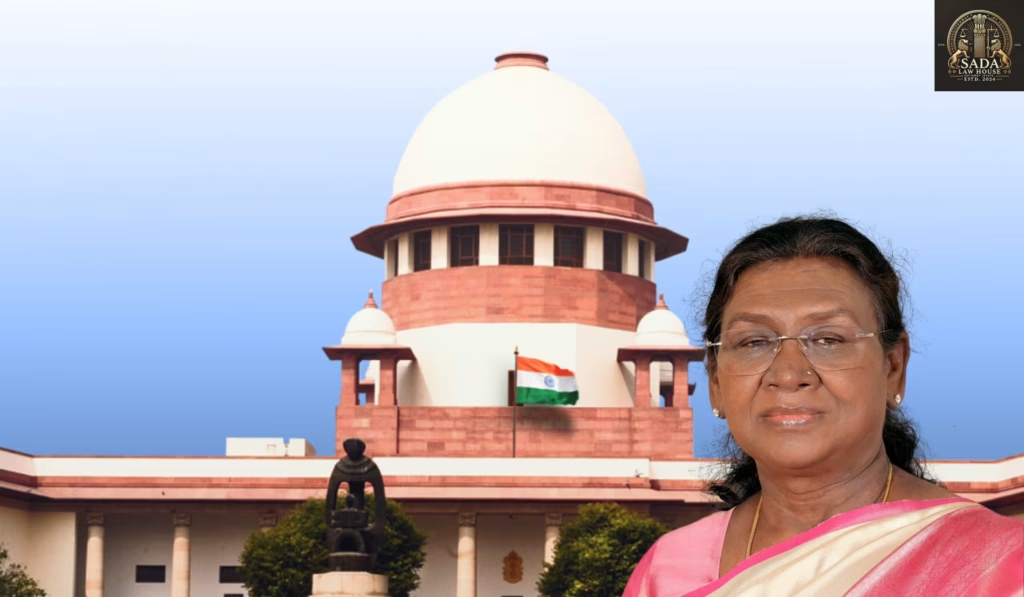
Presidential Reference on Deadlines for Governors: Supreme Court Hearing Enters Day 5

Trending Today Ankita Bhati v. Dev Raj Singh Bhati – Supreme Court Reiterates Wife’s Convenience Paramount in Transfer of Matrimonial Cases (2023) Presidential Reference on Deadlines for Governors: Supreme Court Hearing Enters Day 5 LEGAL INTERNSHIP OPPORTUNITY AT CHAMBERS FOR JUSTICE, DELHI LEGAL INTERNSHIP OPPORTUNITY AT AVNEESH ARPUTHAM LEGAL JOB OPPORTUNITY AT RISHABH GANDHI AND ADVOCATES LEGAL JOB OPPORTUNITY AT UTKRISHTHA LAW OFFICES LEGAL JOB OPPORTUNITY AT DEEPAK SINGH THAKUR & ASSOCIATES Mangilal v. State of Madhya Pradesh – Supreme Court Acquittal for Non-Compliance with Section 52A NDPS Act (2023) Trump Signs Sweeping Economic Orders: Tariffs, Spending Cuts, and Immigration Clampdown China Condemns Gaza Hospital Attack, Calls for Ceasefire Presidential Reference on Deadlines for Governors: Supreme Court Hearing Enters Day 5 Kashak Agarwala 29 AUG 2025 The Supreme Court of India continues hearing the Presidential reference on deadlines for Governors and the President in granting assent to Bills. Key arguments by the Centre, States, and the Bench highlight crucial constitutional questions under Articles 200, 201, and 361. Introduction The Supreme Court of India on Thursday continued hearing the Presidential reference concerning the timelines and procedures for Governors of India and the President of India in dealing with Bills passed by State legislatures. The matter was heard by a five-judge Constitution Bench comprising Chief Justice of India (CJI) BR Gavai, and Justices Surya Kant, Vikram Nath, P. S. Narasimha, and Atul S. Chandurak. The reference was made under Article 143(1) of the Constitution of India by President Droupadi Murmu, following a landmark ruling by the Supreme Court in April 2025 regarding the timelines for gubernatorial assent to Bills. Background of the Dispute In April 2025, the Supreme Court ruled that although Article 200 does not prescribe a strict timeline for Governors to act on Bills, indefinite delays are unconstitutional. The Court directed that: Governors must decide within a reasonable time. Under Article 201, the President must act within three months. Reasons must be recorded for any delay. This ruling arose from a petition filed by the Government of Tamil Nadu, which alleged persistent delays by the Tamil Nadu Governor in granting assent. The Court also clarified that gubernatorial inaction can be judicially reviewed. Dissenting with this interpretation, President Murmu referred 14 constitutional questions to the Court, questioning whether the judiciary can impose such timelines without disturbing the principle of separation of powers. Centre’s Position: Judicial Overreach and Constitutional Immunity Representing the Union government, Solicitor General Tushar Mehta argued that judicial time limits on Governors and the President are inconsistent with the Constitution. His key points included: Article 32 and Article 226 petitions cannot be maintained against Governors or the President. Under Article 361, the President and Governors enjoy constitutional immunity. Forcing them into mandamus proceedings would violate their prerogatives. Governors may withhold assent in the larger national interest if Bills potentially conflict with constitutional norms or national policies. Opposition to the Reference: Governors as Titular Heads Senior Advocate Abhishek Manu Singhvi, appearing for several States, strongly opposed the reference. He argued: Governors and the President act on the aid and advice of the Council of Ministers, except in limited constitutional exceptions. Under Article 200, Governors cannot indefinitely delay assent. Their options—grant assent, return the Bill, or reserve it for Presidential consideration—are all subject to ministerial advice. Historical records of the Constituent Assembly make clear that Governors are not meant to act as “super chief ministers”. If a Bill is unconstitutional, it is the **courts—not Governors—**that must strike it down. Bench’s Observations During the hearings, the Bench made several critical observations: CJI Gavai questioned whether allowing indefinite gubernatorial delays would defeat the will of the legislature. He highlighted that the Constitution’s phrase “as soon as possible” indicates prompt action. Justice Narasimha asked whether Governors had any autonomy when faced with potentially unconstitutional Bills. Singhvi maintained that Governors must still act on advice, with unconstitutional laws left to judicial review. The Bench acknowledged that courts must not disturb the constitutional balance, yet expressed concern over the dangers of indefinite inaction. What’s Next? After detailed arguments, the Constitution Bench adjourned the hearing. The matter will resume on Tuesday, focusing on: The scope of Articles 200, 201, and 361. The maintainability of writ petitions against Governors and the President. The outcome of this case will have far-reaching implications for Centre-State relations, constitutional governance, and the role of Governors in India’s parliamentary democracy. Leave a Reply Cancel Reply Logged in as Sadalaw. Edit your profile. Log out? Required fields are marked * Message* Live Cases Presidential Reference on Deadlines for Governors: Supreme Court Hearing Enters Day 5 Sadalaw • August 29, 2025 • Live cases • No Comments Trump Signs Sweeping Economic Orders: Tariffs, Spending Cuts, and Immigration Clampdown Sadalaw • August 28, 2025 • Live cases • No Comments China Condemns Gaza Hospital Attack, Calls for Ceasefire Sadalaw • August 28, 2025 • Live cases • No Comments 1 2 3 … 5 Next »

Presidential Reference on Deadlines for Governors: Supreme Court Hearing Enters Day 5 Read More »

Supreme Court Urges Elite Couple to Resolve Child Custody Dispute Over Coffee

Trending Today NCLT Dismisses Insolvency Plea Against Dunzo Filed by Invoice Discounters Supreme Court Urges Elite Couple to Resolve Child Custody Dispute Over Coffee Second Bomb Threat in a Week Disrupts Mumbai Airport Operations Supreme Court Collegium Recommends Three New Justices, Appoints Five High Court Chief Justices in Historic Reshuffle JOB OPPORTUNITY AT CHAMBERS OF SHAHRUKH EJAZ JOB OPPORTUNITY AT KANDIVALI EDUCATION SOCIETY’S SHRI JAYANTILAL H. PATEL LAW COLLEGE JOB OPPORTUNITY AT GEHI LAW JOB OPPORTUNITY AT CHAMBERS OF ADV. SHASHI PRATAP SINGH LEGAL JOB OPPORTUNITY AT CHAMBERS OF AKSHAY MOHILEY INTERNSHIP OPPORTUNITY AT A&N LAW OFFICES LLP Supreme Court Urges Elite Couple to Resolve Child Custody Dispute Over Coffee PRABAHAT KUMAR BILTORIA 28 May 2025 The Supreme Court urges a high-profile couple, a fashion entrepreneur and a food business tycoon, to resolve their child custody dispute amicably over coffee, highlighting the human side of family law. Supreme Court Suggests Coffee Meeting to Resolve High-Profile Child Custody Dispute In a high-stakes legal battle, the Supreme Court of India advised an elite couple involved in a child custody case to settle their differences over a casual meeting—perhaps “over coffee or dinner.” The case involves a separated couple: a wife who is a successful fashion entrepreneur and a husband who runs a major packaged food business. Dispute Over Child’s International Travel Sparks Legal Tension The dispute intensified when the wife sought court permission to travel to Europe with their 3-year-old daughter during June and July. The husband refused to sign the necessary travel documents, expressing fears that the child might “disappear” overseas. Supreme Court Encourages Direct Communication Between Parents The court urged the estranged couple to meet privately—without lawyers or family members—to “talk out the issues.” The bench also questioned why the pair, still legally married, couldn’t spend a short vacation together for their child’s sake. The justices remarked, “Traveling abroad is pure luxury,” emphasizing practical parenting over extravagant travel. Father Requests Custody of Child’s Passport The husband argued that he should retain custody of the child’s passport to ensure her safe return to India. He proposed that the wife could travel with her own family while their daughter stayed with paternal grandparents in Mumbai. Legal Mediation and Allegations of Abuse Representing the wife, senior advocate Abhishek Manu Singhvi stated that his client was open to mediation. However, he asserted that reconciliation was impossible due to an allegedly abusive relationship—a claim the husband strongly denied. The wife also stated she did not want her husband to accompany them on the European trip. Supreme Court Hopes for Positive Outcome The bench encouraged the couple to focus on the future and consider reconciliation. The hearing was adjourned with hopes that time spent together might yield a positive resolution. Previous Custody Ruling and Visitation Concerns Previously, the Mumbai High Court granted custody of the child to the mother, allowing her to reside with the child in Delhi. The husband, who lives in Mumbai, told the Supreme Court he had only been allowed supervised visits at the wife’s family home, an environment he deemed unfit for private discussions. Justice Abhay Oka Proposed as Mediator To navigate the complex legal and emotional terrain, the Supreme Court suggested appointing retired Justice Abhay Oka as a mediator. His involvement is expected to facilitate a balanced resolution for both custody and divorce proceedings. Leave a Reply Cancel Reply Logged in as Sada Law. Edit your profile. Log out? Required fields are marked * Message* Live Cases NCLT Dismisses Insolvency Plea Against Dunzo Filed by Invoice Discounters NCLT Dismisses Insolvency Plea Against Dunzo Filed by Invoice Discounters Sada Law • May 28, 2025 • Live cases • No Comments Supreme Court Urges Elite Couple to Resolve Child Custody Dispute Over Coffee Supreme Court Urges Elite Couple to Resolve Child Custody Dispute Over Coffee Sada Law • May 28, 2025 • Live cases • No Comments Second Bomb Threat in a Week Disrupts Mumbai Airport Operations Second Bomb Threat in a Week Disrupts Mumbai Airport Operations Sada Law • May 28, 2025 • Live cases • No Comments 1 2 3 … 5 Next »

Supreme Court Urges Elite Couple to Resolve Child Custody Dispute Over Coffee Read More »

Rajya Sabha Adopts Bill 2025 for Waqf (Amendment)

Trending Today Rajya Sabha Adopts Bill 2025 for Waqf (Amendment) Destruction in Kancha Gachibowli ‘forest’ area depicts an ‘alarming picture’, says SC NCLT Rejects Insolvency Plea Against Zomato Over Payment Dispute Actor Hansika Motwani files a motion in the Bombay High Court to quash a FIR after being booked in a Section 498A case. Supreme Court slams Telangana CM for “making mockery” of anti-defection law Union Minister Kiren Rijiju: The Waqf Amendment Bill Is Prospective Rather Than Retrospective Supreme Court of India Significance of mitigating factors when awarding the death penalty. The Supreme Court permits the petitioner to get involved in ongoing proceedings but rejects another petition contesting the Places of Worship Act. Punjab & Haryana High Court: Child in Womb During Accident Is Subject To Reimbursement Under MV Act What it implies signifies Sam Altman claims that OpenAI’s GPUs are “melting” over Ghibli-style AI art Rajya Sabha Adopts Bill 2025 for Waqf (Amendment) MAHI SINHA 05 Apr 2025 Update: 04 Apr 2025 After a discussion that lasted more than 14 hours, the Rajya Sabha enacted the Waqf (Amendment) Act, 2025 at around 2.22 AM on April 4, after midnight. The law received 128 votes in favor and 95 votes against it. Abstention did not exist. On April 3, the Lok Sabha approved the bill. It is currently awaiting the President of India‘s approval to become legislation. Waqf is a person’s ongoing commitment to any cause that is accepted by Muslim law as benevolent, religious, or pious. On August 8 of last year, the Waqf (Amendment) Bill, 2024 was presented to the Lok Sabha. In order to modernize waqf administration, lower litigation, and guarantee the effective management of waqf holdings, some 40 revisions were recommended to the current Waqf Act, 1995 (as revised in 2013). It was turned over to the Joint Parliamentary Committee (JPC) for a more thorough examination of the suggested modifications following strong opposition criticism. With certain modifications, the Bill has essentially been approved by the JPC. The government and its members made it clear during the discussion on Thursday that the Act aims to guarantee efficient administration of waqf property in order to guarantee that the money received from waqf is distributed fairly for the benefit of Muslims. Kiren Rijiju explained that the user’s provide of waqf is prospective in nature and said that the Government has adopted some of the JPC’s recommendations. Amit Shah of the Ministry of Home Affairs also provided clarification on this. Shah made sure that no one would meddle in Muslims’ religious matters. The Bill seeks to increase efficiency, accountability, and openness, Rijiju noted today. The Waqf Board is only a legal entity, plain and simple, and not an autonomous body of the Muslim body, according to the Kerala High Court‘s ruling in “Syed Fazal Pookoya Thangal vs. Union of India And Ors,” which he referenced. Rijiju defended the choice to include two non-Muslim members, saying that the government has no intention of meddling in religious matters and only wants to make the ruling party more secular. Hazif Mohd Zafar Ahmd v. UP Central Sunni Board of Waqf, another Allahabad High Court ruling that noted that Mutawalli’s function is secular and not a religious ritual, was also mentioned by Rijiju. The federal government guided the 2013 modification introduced during the Indian National Congress‘s longevity,” said House Leader JP Nadda today. However, the government discovered in 2020–21 that the waqf property had only grown by 18 lac hectares between 1913 and 2013, while 21 lac hectares of waqf assets were added between 2013 and 2025. The government introduced this bill to make sure it wasn’t abused. Nadda said that because the 2013 amendment gave the waqf board exceptional powers, it seemed to override the nation’s constitutional structure. He said that it turned into a harsh legislation. He cited Section 40 of the Parent Act in particular, stating that the Waqf Board has the authority to determine whether a property qualified as a waqf asset on its own. Additionally, he cited the clause that prohibited residents from contesting the waqf tribunal’s ruling in ordinary courts, claiming that this was against Article 21. Additionally, Section 54 was cited, which, in Nadda’s opinion, permitted the Tribunal’s decision to remove the encroachment. In contrast, civil courts were prohibited from pursuing any legal action under Sections 5 and 6 of the Parent Act. The Leader of the Opposition, Mallikarjun Kharge, queried why, if the government wants the wellbeing of Muslims, it has halted five programs that assist them. Additionally, he stated that the Ministry of Minority Affairs funding is still being cut by the governing body. Kharge noted that the Government initially granted the Collector jurisdiction and then transferred that authority to a designated State official above the Collector’s legitimacy, rather than the Survey Inspector doing an initial investigation into the waqf land. The opponents claimed that the government was attempting to split the populace along religious lines and criticized the bill for breaching Article 25 of the Constitution. A few members also had concerns about how the JPC operated. According to Dr. Syed Naseer Hussain, the government welcomed non-stakeholders for the first time today since they were aware that the vast majority of people opposed the proposal. According to Dr. Abhishek Manu Singhvi, the Bill blatantly disregards Articles 25 and 26 of the Constitution. He went on to say that he has participated in some important cases, including those involving the Sabarimala temple and the Dawoodi Bohra community, and in these rulings, the Supreme Court has unequivocally declared that a custom or execute fully falls under the safeguards of fundamental rights provided by Articles 25 and 26 once it is deemed a necessary part of religion. Singhvi cited Ratilal Panachand Gandhi v. State of Bombay, saying that a statute that completely removes a religious denomination’s administrative power and transfers it to a different, more secular body would violate Article 26 rights. Singhvi of Tilkayat Shri Govindlalji Maharaj vs. The State of Rajasthan also cited this

Rajya Sabha Adopts Bill 2025 for Waqf (Amendment) Read More »