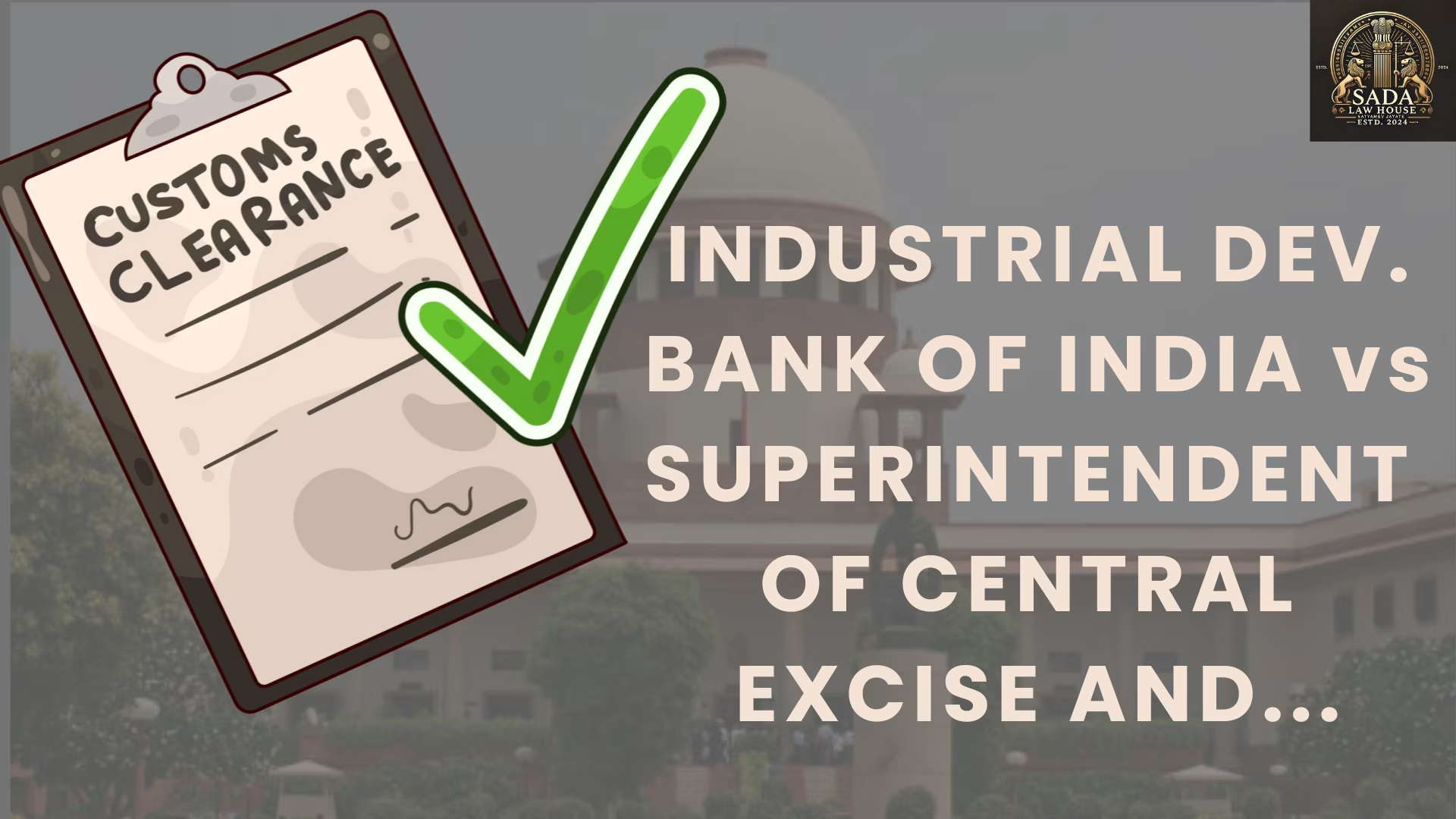
Industrial Development Bank of India (IDBI) vs Superintendent of Central Excise and Others
PRABHAT KUMAR BILTORIA
16 October, 2025
Introduction
This case deals with the priority of claims during the liquidation of a company — specifically, whether the rights of a secured creditor (IDBI Bank) under the Companies Act, 1956, take precedence over customs dues claimed by the government. The Supreme Court was asked to determine if the Customs Department could claim priority over the sale proceeds of goods warehoused by the company to recover customs dues. The case also involved examining the correctness of an earlier Full Bench decision by the Andhra Pradesh High Court.
Background / Facts of the Case
M/s Sri Vishnupriya Industries Ltd. took a loan from IDBI Bank and hypothecated imported machinery and mortgaged immovable assets as security.
The machinery, imported from Italy, remained in bonded warehouses between 1998–1999 due to non-payment of customs duties.
Customs authorities issued notices demanding over ₹13.75 crore in duties and initiated the sale of goods under Sections 72(2) and 142 of the Customs Act.
In 2003, the company went into liquidation and a winding-up order was passed in December 2003.
The Official Liquidator sought to take possession of the goods, but the Andhra Pradesh High Court Full Bench ruled that customs authorities had the first claim.
IDBI appealed to the Supreme Court.
Issues of the Case
Do customs authorities have the first charge over warehoused goods for recovery of customs dues under the Customs Act?
Does a secured creditor (IDBI) have priority payment rights under Section 529A of the Companies Act during liquidation?
Can government dues override secured creditors’ rights in liquidation?
Was the Andhra Pradesh High Court’s reliance on earlier precedents like Dytron India Ltd. correct in law?
Judgment
The Supreme Court allowed the appeal and set aside the Andhra Pradesh High Court’s ruling.
Key Observations:
1. Priority under Section 529A of the Companies Act
Section 529A has an overriding effect on all other laws.
It grants secured creditors and workers priority in payment during liquidation proceedings.
2. Customs Duties Not Preferential
Customs dues in this case were not payable within one year before winding-up, hence not “preferential debts” under Section 530.
Therefore, customs dues did not override the secured creditor’s rights.
3. Customs Act Does Not Create a First Charge
Sections 72 and 142 of the Customs Act do not establish a first charge over property.
No express statutory provision gives customs authorities precedence over secured creditors.
4. Section 142A (2011 Amendment)
Introduced a statutory first charge but explicitly preserved secured creditors’ rights under Section 529A.
Not applicable retrospectively to disputes prior to 2011.
5. Error in Dytron India Ltd. Judgment
The Andhra Pradesh High Court’s reliance on Dytron India Ltd. was misplaced as it contradicted Supreme Court precedents and statutory interpretation.
Conclusion
The Supreme Court reaffirmed that in the liquidation of a company, secured creditors’ rights and workers’ dues take precedence under Section 529A of the Companies Act, 1956. Government dues, including customs duties, cannot supersede these rights. The decision underscores the non-obstante clause of Section 529A and the principle that recovery powers under special statutes like the Customs Act must yield to the priority framework established by the Companies Act. Consequently, IDBI Bank was entitled to the sale proceeds of the goods ahead of the Customs Department.